Bulgarian voters expect significant political realignments if early parliamentary elections are held in the spring, according to a national survey by Alpha Research conducted between 5 and 12 December.
Current voter attitudes point to a trend towards another fragmented parliament and narrowing gaps between the main political competitors, the poll shows.
What kind of government, around which political forces, is acceptable and/or desirable for Bulgarians?
What Kind of Government Do Bulgarians Want?
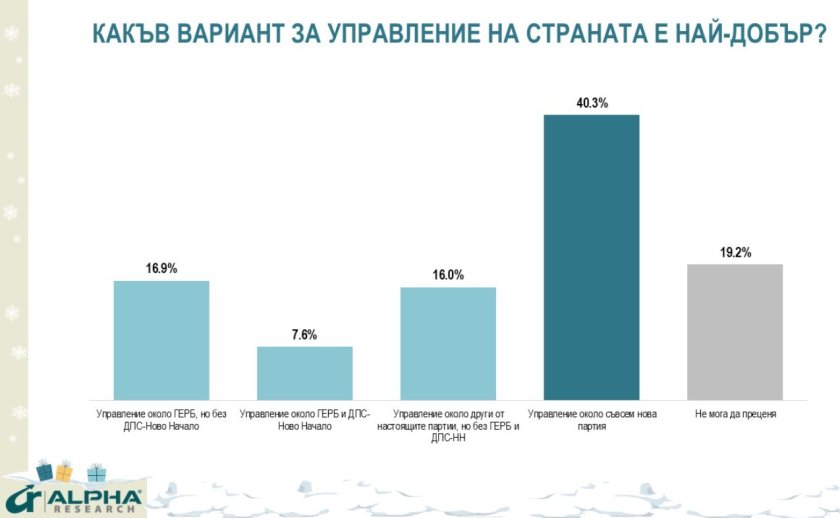
Asked which political forces they would find acceptable or desirable to form a government:
7.6% support a government centred on GERB and MRF – New Beginning
16.9% favour a government led by GERB but without MRF – New Beginning
16% support a government built around other existing parties, excluding both GERB and MRF–New Beginning
40.3% prefer a government centred on a new political force
However, in Bulgaria’s divided and fragmented society, there is no clear vision, and even less consensus—on what such a new force should look like.
Based on statistical modelling, and noting that the participants in a potential election race are not yet known, sociologists outline several indicative scenarios for this 40%:
Whether this 40% turns out to vote at all, and how their vote is structured, will be decisive for three key outcomes, sociologists say: the result of early elections, whether a government can be formed afterwards, and the nature of any future government.
During the week of protests and the government’s resignation, declared readiness to participate in early elections rose by between five and seven percentage points. This suggests that between 300,000 and 500,000 additional voters could turn out.
One remaining uncertainty is the behaviour of Generation Z, which has been actively involved in the protests.
Nearly 10% of those intending to vote say they would support parties other than those currently represented, while 13.3% remain undecided—shares that are not yet consolidated around specific political players, but are large enough to reshape the political landscape, Alpha Research notes.
Public dissatisfaction with the government has reduced GERB’s electoral support by just over four points. The party remains in first place with 21.4% among decided voters, if elections were held today.
GERB leader Boyko Borissov retains 21.6% trust, but distrust has risen sharply to 58.8%. It remains to be seen whether the government’s resignation—presented by Borissov as a “rescue move”—will halt the erosion of confidence.
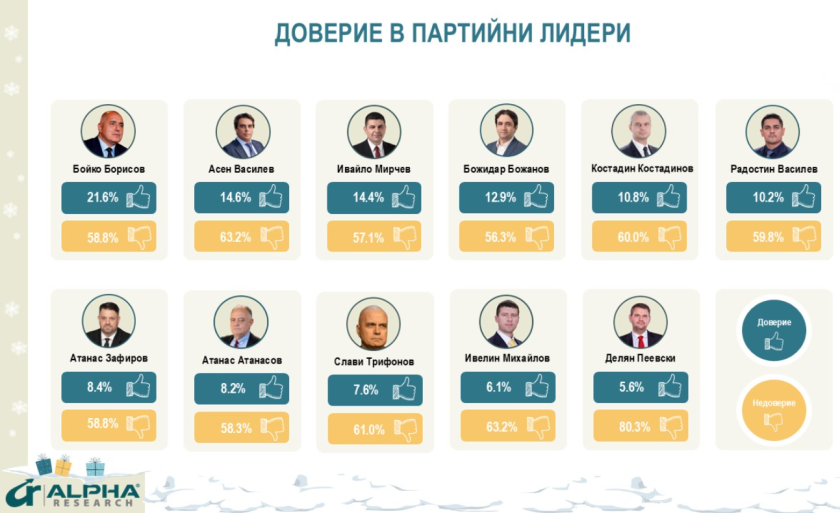
After aligning themselves with public sentiment and backing mass protests, the We Continue the Change – Democratic Bulgaria coalition has entered a positive trajectory. Support for the coalition has risen by nearly four points to 17.8%. Coalition leaders are not reaping personal dividends, but remain in good positions.
Vazrazhdane ranks third with 11.6% support. Its leader Kostadin Kostadinov records 10.8% trust and 60% distrust.
Delyan Peevski, leader of MRF– New Beginning, remains the most unpopular political figure, with just 5.6% trust and 80.3% distrust, and with a declared higher willingness to vote, the party is relegated to fourth position with 9.4% of those firmly decided to vote.
Coalition partners Bulgarian Socilaist Party (BSP) and 'There Is Such a People' are among those hardest hit by shifting public attitudes and are currently hovering around the parliamentary threshold.
Support for the BSP has shrunk to 4.9% and approval for leader Atanas Zafirov to 8.4% (and 58.8% disapproval). 'There Is Such a People' is backed by 3.8% of those who decided to vote, while approval for their leader Slavi Trifonov drops to 7.6% (and 61% disapproval).
Morality, Unity, Honour (MECh) stands at 4.2%, with uncertain prospects for entering Parliament. Trust in its leader Radostin Vassilev is 10.2%, against 59.8% distrust.
'Velichie' (2.1%) and 'Alliance for Rights and Freedoms' (1.6%) remain outside the projected next Parliament.
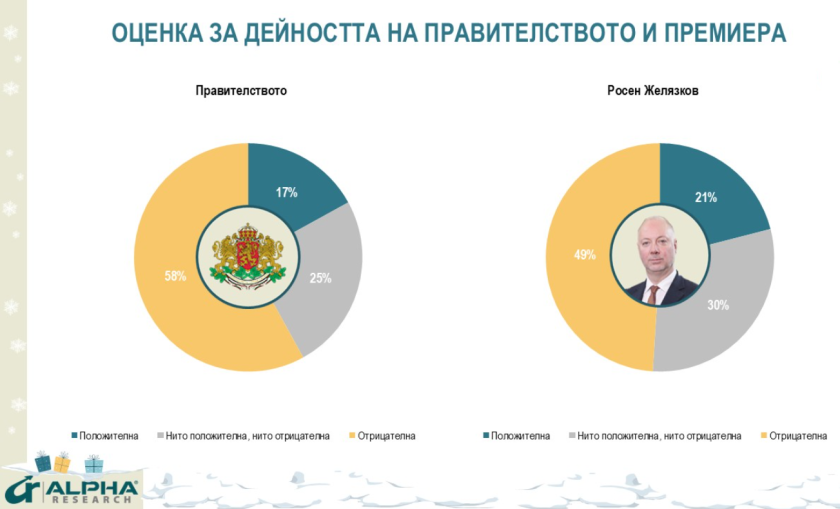
After months of serious political, economic and social challenges, the coalition government leaves office with 17% positive, 25% neutral and 58% negative assessments.
Prime Minister Rosen Zhelyazkov departs with 21% positive, 30% neutral and 49% negative ratings—levels comparable to most coalition governments at the end of their terms over the past 15 years.
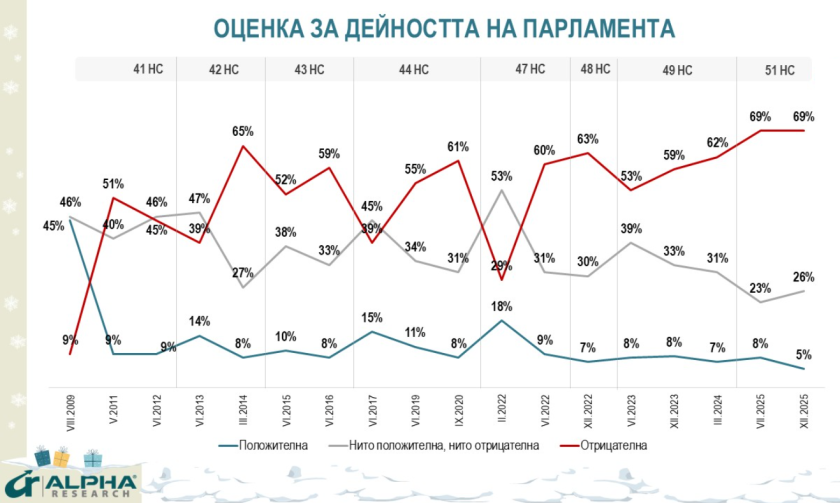
Stronger is the public dissatisfaction with the performance of the 51st Parliament, which has become a site of incessant political confrontation and unpleasant scenes. At the end of the year, the parliament received an approval rating of only 5%, disapproval of 69% and a 26% neutral attitude, with even supporters of the parties represented in it being highly critical.
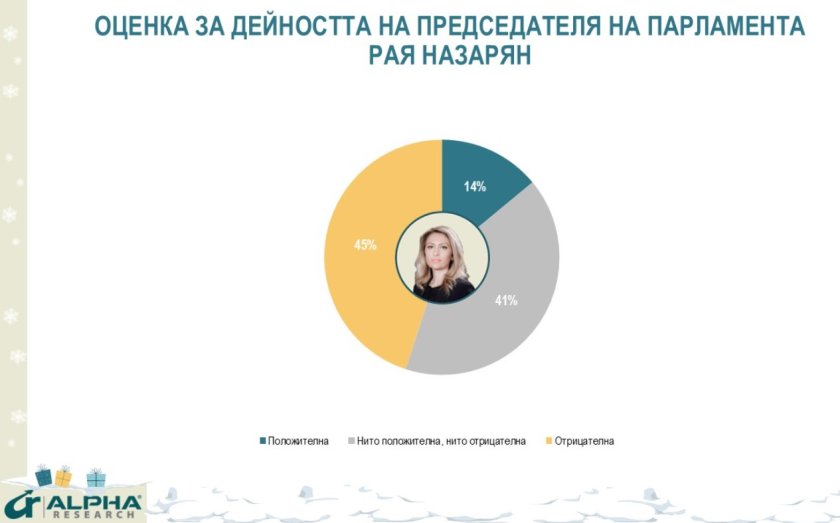
Parliament Speaker Raya Nazaryan is trusted by 14% (mostly GERB supporters), distrusted by 45% and 41% neutral.
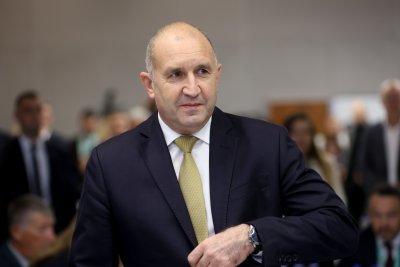
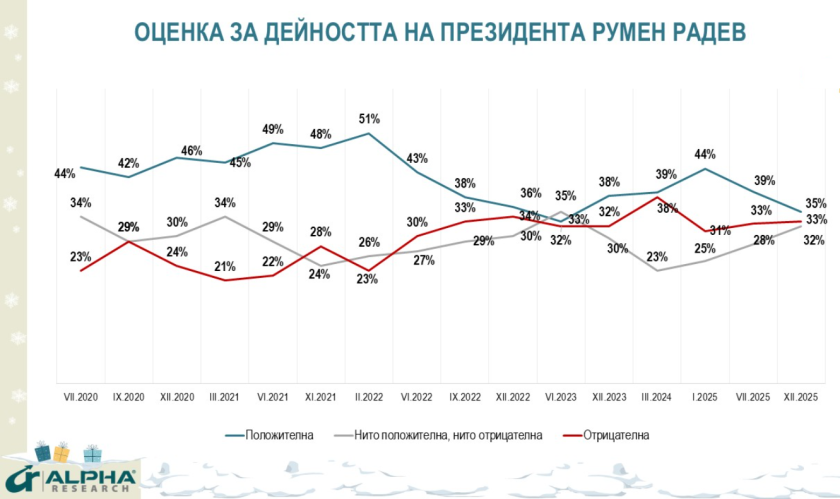
President Rumen Radev retains the strongest institutional rating, though he too has been affected by the overall negative trend. Trust in him has fallen by four points to 35%, with 33% distrust and 32% neutral views. His criticism of euro adoption and positions on geopolitics have alienated pro-European voters.
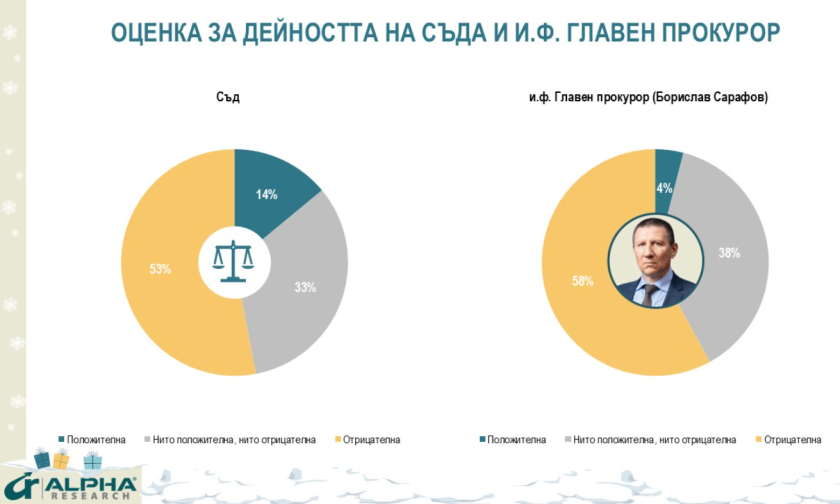
This year, public attitudes towards the judiciary remain at the usual levels of distrust. The most critical is the attitude towards acting Prosecutor General Borislav Sarafov (4% positive, 38% neutral and 58% negative). Approval of the court's activity is 14%, against 53% disapproval and 33% neutral attitude.
The biggest protests of the last ten years have put both ruling and opposition parties in a completely new political situation. The results on the key question - public support for the protests - show very high, nationwide, approval. 59% express full solidarity with them, against 16% of the opposite opinion.
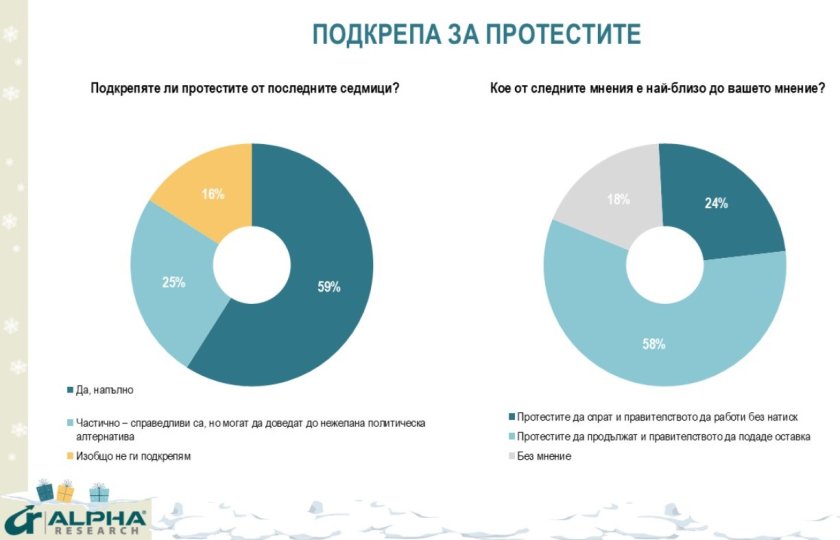
Graphs by Alpha Research
Approval dominates across all social and electoral groups, with the exception of supporters of the GERB–UDF alliance and the more hesitant stance of backers of BSP and TISP. Disapproval, at 16 per cent, is well below the combined level of electoral support for the governing parties.
Between these two poles, the survey identifies a distinct trend: 25 per cent of respondents consider the protests justified and therefore partially support them, but fear they could lead to an unacceptable political alternative. This view is shared by every second GERB supporter, every third supporter of BSP and of MRF – New Beginning, and only marginally by supporters of the other political forces.
The high social energy of the protests, their rapid spread across a large number of cities, and the growing sense of the power of civic mobilisation have also altered perceptions of the stability of the current government—something that until recently had been regarded as unrealistic. In the survey, 58 per cent of respondents said the protests should continue and lead to the resignation of the government, compared with 24 per cent who believed the cabinet should have remained in office.
In this context, the government’s decision to resign immediately after the third major protest aligned with public expectations, but also placed political parties in a position where they should must adjust their behaviour to rapidly shifting public attitudes.
The survey was conducted between 5 and 12 December 2025 as part of Alpha Research’s regular monitoring programme. It covered 1,000 adults nationwide, using a stratified two-stage sample with quotas based on key socio-demographic indicators. Data were collected through face-to-face standardised interviews conducted via tablets in respondents’ homes.


 Minister of Energy Iva Petrova: The Danube's Water Level Remains Critically Low
 The Election of Bulgaria's Seventh President Will Be Decided in a Run-off on November 1
 "Това е победа на смелостта над страха": Студентите в Сърбия ликуват след триумфа на изборите









 Чуй новините
 Подкаст