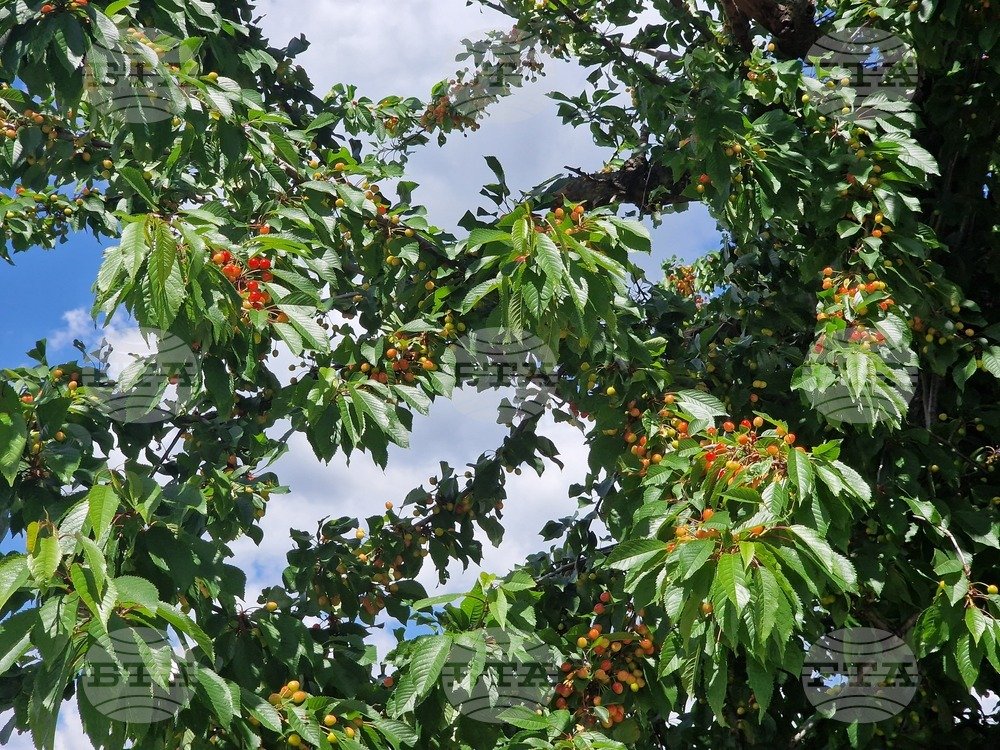
Cherry picking and purchasing have begun in the Kyustendil region, Southwestern Bulgaria. After two consecutive years in which spring frosts caused serious damage to orchards, producers are once again facing difficulties. Despite unfavourable weather conditions, some orchards have been preserved, and cherries are already reaching the market.
In the first days of the purchasing campaign, the buying price for cherries intended for processing ranges between 80 and 90 euro cents per kilogramme. However, producers say this price is insufficient given the low yields and rising costs.
Milen Georgiev from the Association of Agricultural Producers commented on the issue.
“The purchase price this year, I can say with confidence, would have been normal if the quantities on the trees were like in a normal year. What we are currently observing, both I and my colleagues, is an average yield of around 300–400 kg per decare. When you do the calculations and deduct labour costs, preliminary preparation and orchard maintenance, I believe that with this year’s yields per decare and these purchase prices of 80 to 90 cents, we will end up at zero. There will be no significant profit,” said Milen Georgiev, chair of the National Association ‘United Agricultural Producers’, on the programme “The Day Begins” on June 18.
According to him, the situation is fundamentally different from that of a normal agricultural year:
“For viewers, we should explain that the yield per decare of cherries in a normal year is around one and a half tonnes. This year we will have around 300–400 kg on average for the orchards that survived. Around 30% of cherry plantations have survived, but even in those there are considerable losses. When the season ends and the balance is made, colleagues will likely be able to say they are either at zero or minimal profit.”
Georgiev clarified that the current purchase prices apply to cherries intended for processing plants, not for fruit reaching consumers through retail channels.
“This purchase price of 80 to 90 cents is for processing in factories, where we are offering only the raw material. There are still no active traders in the Kyustendil region, as the period coincides with harvesting in other areas where production is very strong. Therefore, we cannot yet speak about what the purchase price from traders will be. I sincerely hope it will be much higher than the one at the collection points.”
He emphasised that the quality of Kyustendil cherries remains high despite the difficult year:
“Cherries at the collection points are of lower quality, but I am referring only to their external appearance. Otherwise, Kyustendil cherries, even when smaller, are always sweet and tasty.”
Producers note that comparisons with previous years are difficult due to inflation and rising production costs.
“After the inflation we have experienced, it is not very accurate to compare prices directly with years ago. In real terms, around 80 cents is roughly equivalent to past values in leva, but purchasing power is no longer the same. Labour costs have increased significantly, as have all other expenses. Overall, there is currently no real light at the end of the tunnel, and things do not appear to be improving for us.”
For now, it remains unclear at what price cherries will reach consumers. Producers are mainly selling for processing, while the real market price will become clear as traders enter the market and supply increases in the coming weeks.


 PM Rumen Radev: German Investments Are a Driving Force Behind Bulgaria's Industrial Development and Bring Successful Business Models into the Economy
 Eurostat: Bulgaria Records EU’s Fastest Rise in Fuel Prices for Second Consecutive Month
 Илияна Йотова: Илюзия е, че ако не се гласува, можем да извършим промяна в страната
 Историческа победа за студентите, Вучич призна загубата си на парламентарните избори в Сърбия










 Чуй новините
 Подкаст