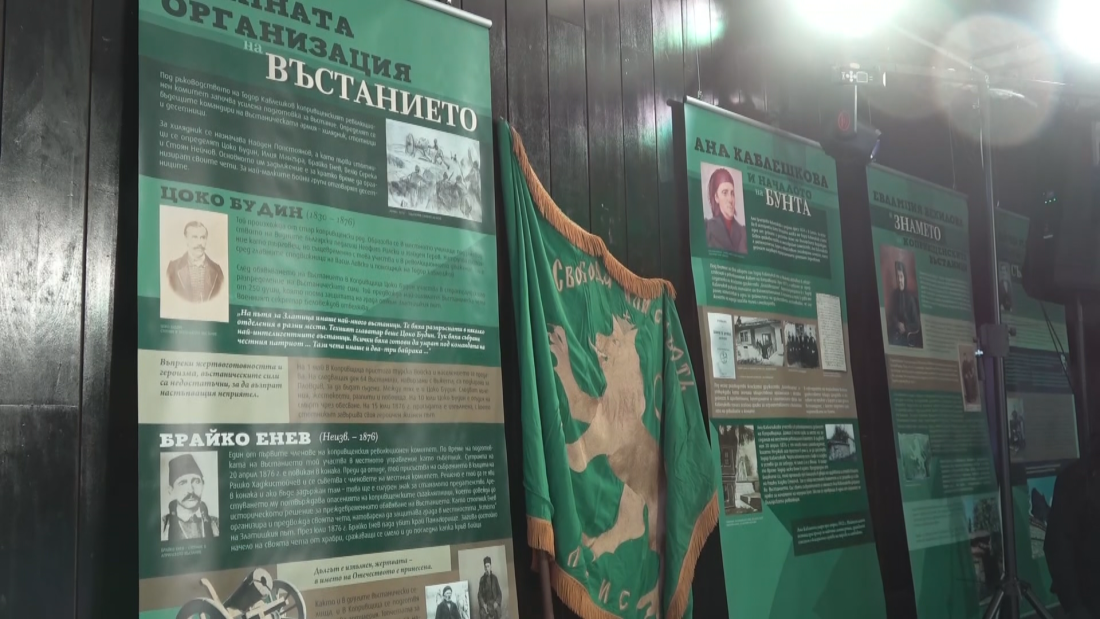
Prominent faces of Bulgarian National Television — Adelina Radeva and Boyko Vasilev — together with historian Prof. Plamen Mitev, are taking part in the public affairs stage production The Uprising – A World News Story. It is dedicated to the 150th anniversary of the April Uprising. Its premiere took place at the Regional Historical Museum – Smolyan in Smolyan (Southern Bulgaria).
The figures of the heroes of Bulgaria’s struggle for liberation — Georgi Rakovski, Vasil Levski, Georgi Benkovski and Hristo Botev — are portrayed through the perspective of contemporary journalists. They pose the questions, while the historian provides the answers.
Prof. Plamen Mitev, historian:
“There are many ways to tell the story of the April Uprising, but I believe the time has come to break away from the familiar approaches and seek something that can reach the hearts and minds of Bulgarians more directly and more swiftly. Textbooks are not enough; a dry narrative cannot recreate that atmosphere of hope, faith, and also of much death, violence and betrayal.”
The role of the journalist Januarius MacGahan is particularly emphasised, as it was thanks to his reports on the massacres following the uprising that it became became world news.

Adelina Radeva, journalist at BNT:
“The April Uprising was, quite literally, world news — and in that sense it proved successful despite its defeat. That was the intention of its organisers, and it was achieved by my colleagues 150 years ago, such as MacGahan, who spread the news. Reports of the atrocities effectively shifted diplomacy and the positions of the Great Powers towards Bulgaria.”
Boyko Vasilev, journalist at BNT:
“It is remarkable how young people in their early twenties managed not only to die for Bulgaria, but to achieve their real aim. In short, an uprising becomes news through two things — the massacares and its heroes. With the blood that was shed and the figures who showed the world that there were Bulgarians who valued freedom above wealth, the April Uprising ultimately paved the way for Bulgaria’s liberation.”
Thus, the unconventional production offers its own answer: the April Uprising ultimately achieved its most important goal — freedom.

***
The April Uprising broke out prematurely on April 20 in 1876 (May 2, New Style calendar). It was suppressed by the Ottoman authorities, but produced a wide international response and indirectly resulted in the establishment of Bulgaria as an independent nation in 1878.
Despite the defeat and atrocities committed by the Ottoman Empire in Batak, Perushtitsa, Klisura, Panagyurishte, the action was a political success, making the Bulgarian question part of the agenda of European diplomacy at the time.






 Чуй новините
 Подкаст