On 19th of February, 2026, Bulgaria marks 153 years since the death of national hero Vasil Levski, with commemorations taking place throughout the day.
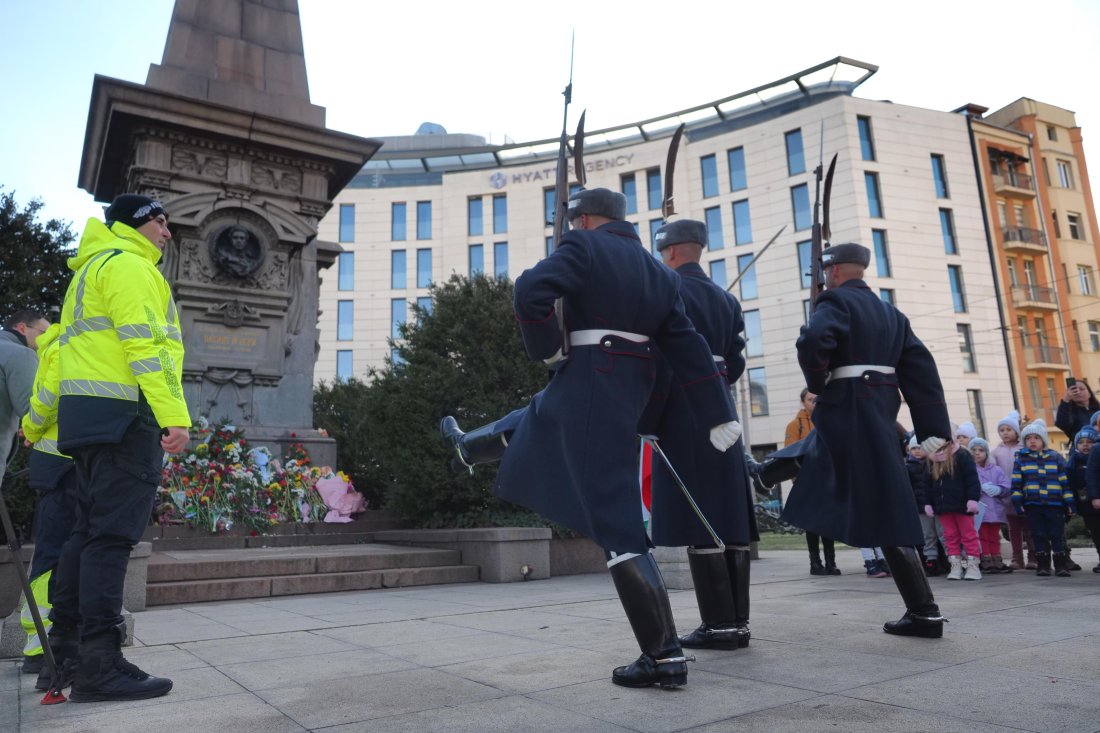
In Sofia, a memorial ceremony is scheduled for 18:00 local time, while large crowds have already gathered to pay their respects at the monument to the Apostle of Freedom.
By tradition, people lay flowers at the monument in the capital, and as in previous years the queue of visitors stretches far beyond sight.
“He fought for freedom because he was very brave,” said Krasi.
“This is his first time here, because until now he was very young. It’s very important — he is our symbol of humanity, of virtue, of everything that ought to matter today,” said Snezhana.
***
Vasil Ivanov Kunchev
Vasil Levski was a leading figure in the fight of the Bulgarian people against Ottoman rule in the late 19th century. He was a revolutionary, democrat, ideologist, organiser and leader of the Bulgarian national liberation movement, founder of the Internal Revolutionary Organisation (IRO) and of the Bulgarian Revolutionary Central Committee (BRCC).
He participated in the First Bulgarian Legion (1861 - 1862), where he was given the name Levski for his bravery and agility. He worked as a teacher in Voinyagovo, Karlovo, and in the village of Eniköy, Tulcha (1864 - 1867). In 1867, he moved to Romania to join the armed detachments being prepared to cross into Bulgaria. He also took part in the formation of the Second Bulgarian Legion (1867 - 1868).
Vasil Levski made two tours across Bulgaria – the first from December 11, 1868, to February 24, 1869, and the second from May 1 to August 26, 1869. During these trips, he established the first revolutionary committees in Bulgaria, in Lovech, Pleven, Karlovo, and Sopot.
In the autumn of 1869, he participated in the founding of the Bulgarian Revolutionary Central Committee (BRCC) in Bucharest, Romania. On May 27, 1870, he returned to Bulgaria and established the Internal Revolutionary Organisation (IRO). At a General Assembly of the BRCC in Bucharest (April 29 - May 4, 1872), he was confirmed as the "chief apostle of all of Bulgaria, Thrace, and Macedonia." Afterward, he left Bucharest and continued his apostolic mission within the Bulgarian lands.
On December 27, 1872 (Old Style), he was captured by the Ottoman authorities at the Kakrinski Inn. From January 5 to 10, 1873 (Old Style), he was interrogated by a Special Investigative Commission, which on January 14 (Old Style) prepared a final protocol recommending his death sentence. On January 22 (Old Style), with a decree from Sultan Abdul Aziz, his death sentence was confirmed. On February 6 (Old Style), February 18, 1873 (New Style), he was hanged on the outskirts of Sofia by the Ottoman authorities.
As part of the tradition, every year on February 19, the anniversary of his death is marked, with solemn celebrations taking place throughout the country.







 Чуй новините
 Подкаст