Every year on 1st of March, Bulgarians celebrate a centuries-old tradition called the day of Baba Marta (baba means ‘Grandma’ and Marta means ‘March’), related to sending off the winter and welcoming the approaching spring.
They are worn either until 9 March, the church feast of the 40 Holy Martyrs, or until 25 March, the Annunciation. The martenitsa can also be taken off at the first sight of a stork, a swallow, a cuckoo or a flowering tree.
Wearing and giving martenitsas
On that day and a few days afterwards, Bulgarians exchange and wear the so-called “Martenitsas” - a small ornament (usually a tassel, a bracelet or necklace), made of twined red and white threads – woolen, silk, or cotton, which Bulgarians tie around their wrists or clip on their clothes every year on March 1 for health and good luck.
The Martenitsas are given as a gift to friends, family and colleagues to bring them good health, good fortune and a good harvest. In some villages in the mountains, people decorate their houses and domestic animals.
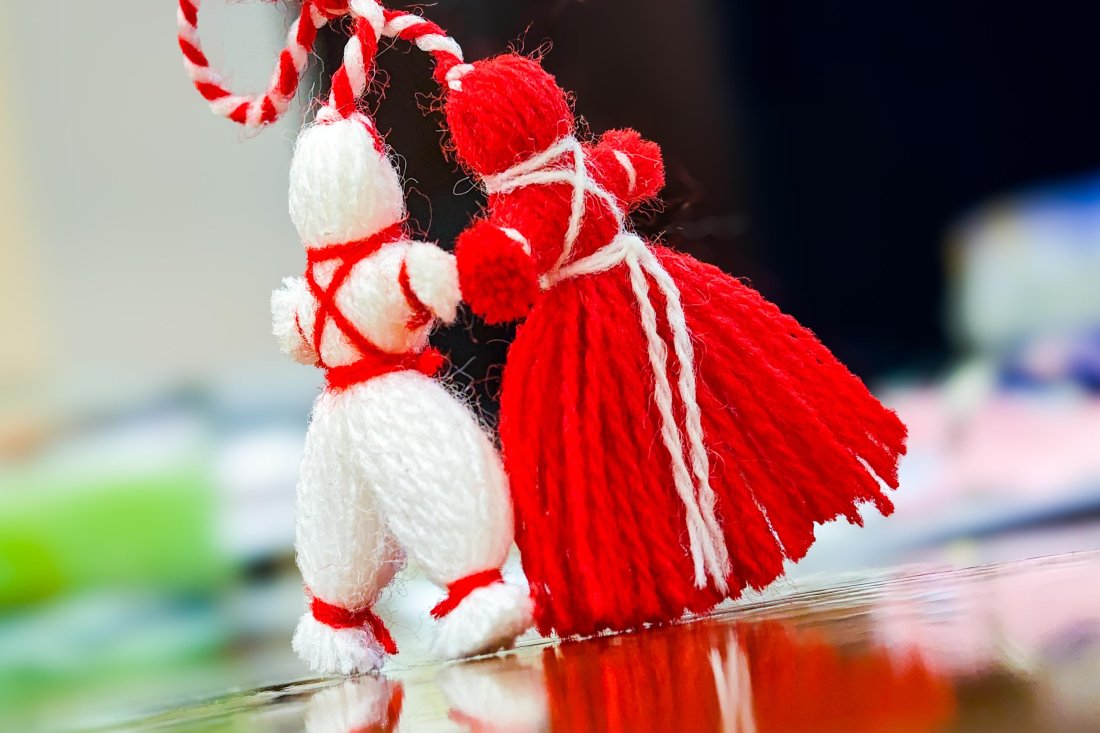
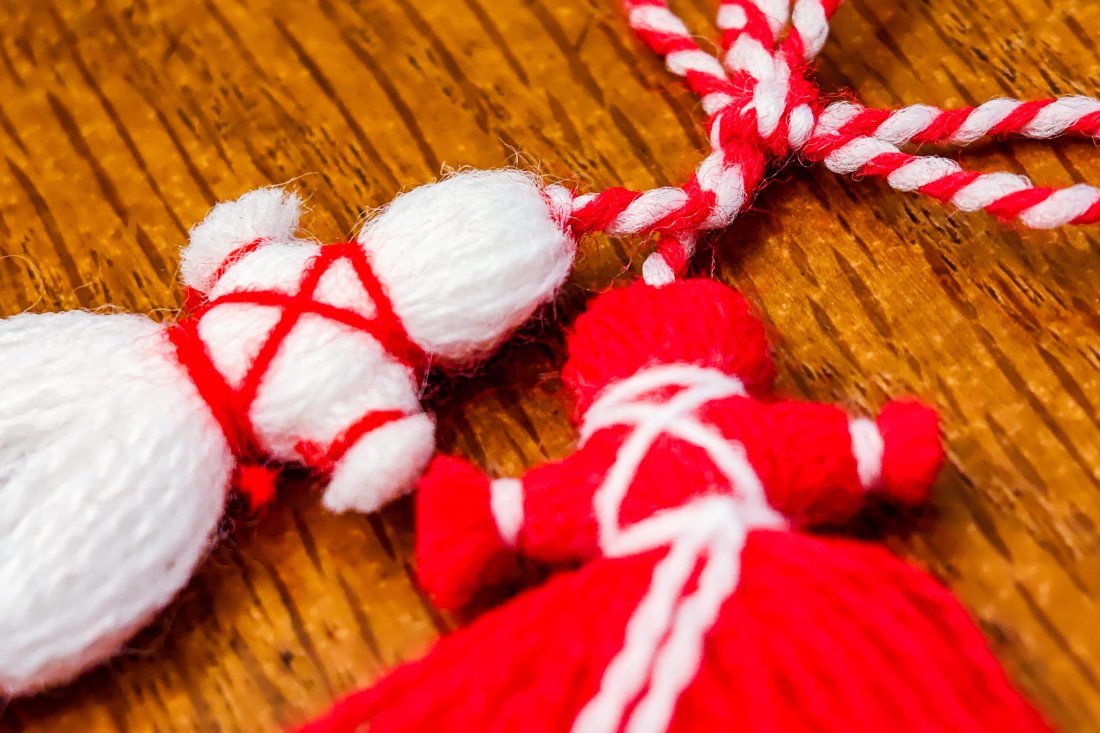
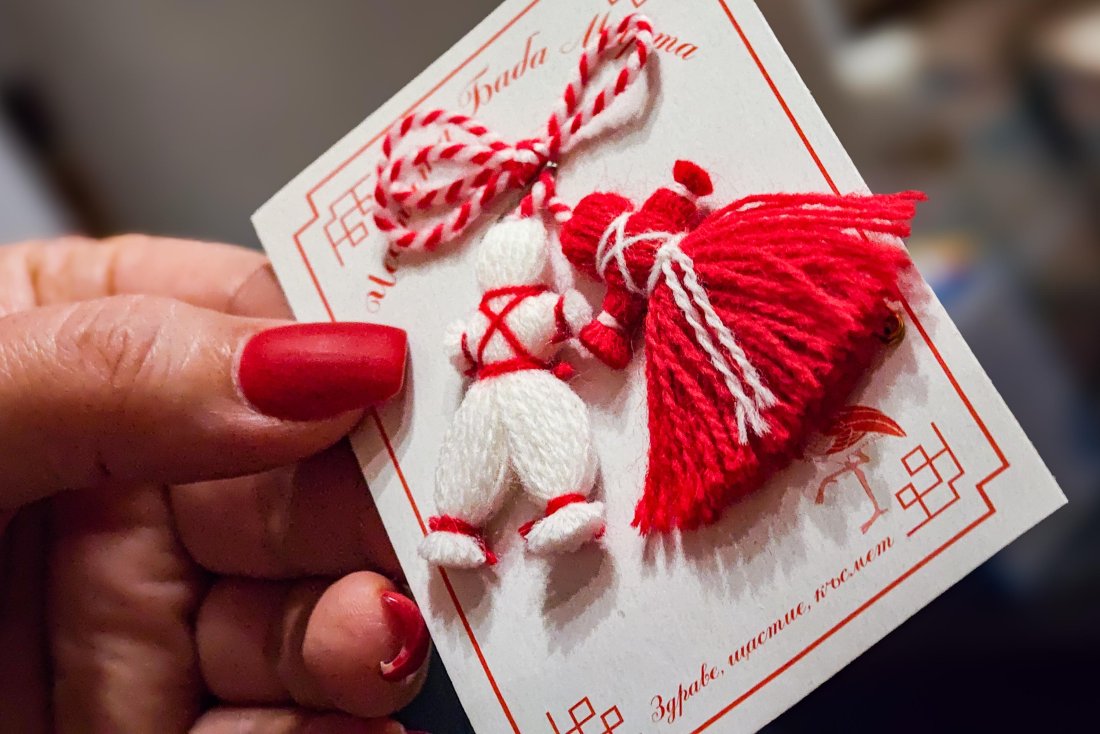
The most typical Martenitsa represents two small dolls, known as Pizho and Penda.
This ancient, probably pagan custom is considered a unique Bulgarian tradition, although it is also present in Romania in a slightly modified form. There, the martenitsa is called a "martishor" and is worn only by women, while in northern Greece it is worn only by children as a bracelet made of twisted white and red thread. The custom is also kept in nearby countries where Bulgarians have migrated over the centuries - it is celebrated in the southern parts of Moldova where ethnic Bulgarians live.
The custom of hanging martenitsa is widespread not only in Bulgaria, but also in other Balkan countries. In 2017, it was also included in the UNESCO Intangible Cultural Heritage of Humanity List as a joint nomination by Bulgaria, Romania, Moldova and the Republic of North Macedonia. On the Bulgarian side, Prof. Dr. Albena Georgieva, an expert from the Institute of Ethnology, Ethnography and Folklore Studies with the Ethnographic Museum at the Bulgarian Academy of Sciences, took part in the preparation of the nomination.
Photos by BGNES
Interesting are the customs in our country related to martenitsas. In the region of Razgrad, at sunrise in the morning, every housewife throws a red cloth on one of the fruit trees in the garden "to make Baba Marta laugh". In the Troyan region, on 1 March before sunrise, the housewives of each home tie red wool on the door locks, on the fruit trees, on the horns of the cattle. In Haskovo, the grandmother who ties martenitsi to the children of the family early before dawn dresses herself entirely in red outerwear.
Martenitsas come in a variety of shapes and sizes: bracelets, necklaces, tassels, pompoms and balls. The white is a symbol of purity, innocence, beauty and joy. The red is associated with health, vitality, fertility and bravery.
According to the tradition, people wear Martenitsas for a certain period, the end of which is usually associated with the first signs of spring – seeing a stork or a fruit tree in blossom.
When a sign of spring is seen, the martenitsas are tied onto tree branches thus giving the tree health and luck, which the person wearing the Martenitsa enjoyed while wearing it.
Baba Marta in the Bulgarian folklore
In Bulgarian folklore, Baba Marta is a mythical figure who brings with her the end of the cold winter and the beginning of spring.
"Grandma Marta" or "Baba Marta" was believed to be a grumpy old lady who changes her mood very rapidly and it reflects in the changeable March weather that on one day it may be warm and sunny, and on the next it may be cold and cloudy.
The belief was that when she was smiling, the weather was sunny and warm, but if she got angry the cold would stay longer and may even snow. By wearing the red and white colours of the Martenitsa, our predecessors asked Baba Marta for mercy. They hoped that it would make winter end quickly and bring spring.
Young and old would take care to keep Baba Marta in a good mood. Young would get up early before anybody else in order to meet the first day of March and rejoice Baba Marta with their youth and beauty. Old women would knit twisted strands of red and white threads to decorate the house. They were believed to protect people from diseases and evil forces. The housewives used to hang out red aprons, belts, rugs or twisted threads in front of their houses, hoping that when Baba Marta saw them, she would laugh and make the Sun shine bright again.
The custom of wearing Martenitsa is probably one of the most interesting Bulgarian traditions. According to one of the many legends, this tradition is associated with the founding of the Bulgarian state in 681 AD. The first martenitsa was made by Ahinora, the wife of Khan Asparuh (the founder of Bulgaria) in the second half of the seventh century, when Asparuh crossed the Danube and found the Bulgarian lands. Ahinora, while waiting for her husband, decided to send him wishes for good health and prosperity. She tied a twisted white and red thread to the leg of a swallow and sent the bird to deliver the message for health and love.







 Чуй новините
 Подкаст