Valuable historic houses classified as cultural monuments in Plovdiv are continuing to deteriorate, with many buildings in poor condition despite their architectural and historical significance.
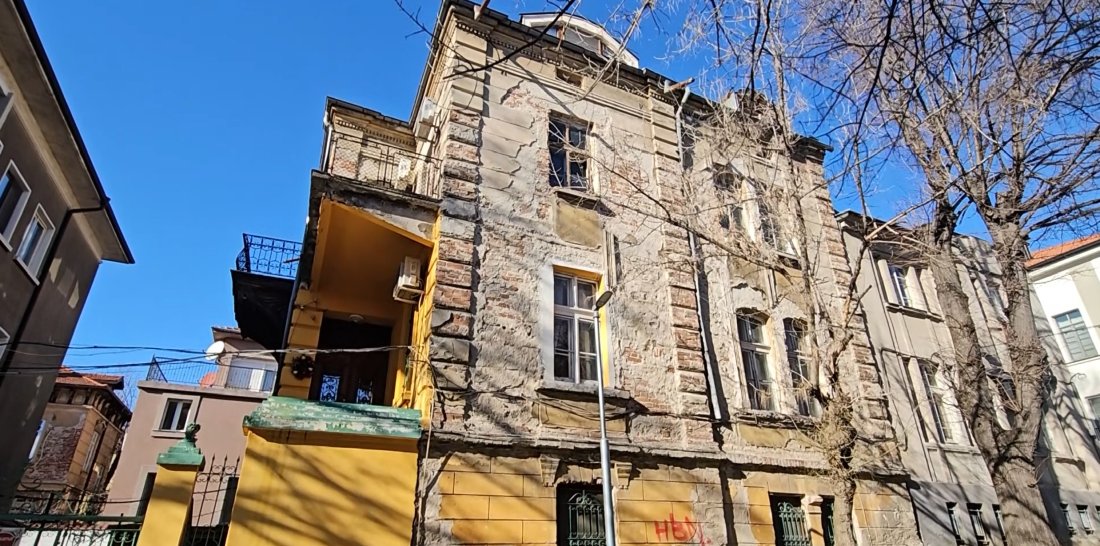
Valuable historic buildings in Bulgaria's second largest city of Plovdiv continue to deteriorate, with a number of privately owned cultural heritage houses in dangerous condition, including some within the architectural reserve Old Town of Plovdiv. Local authorities are now exploring a special support programme to help owners preserve properties classified as immovable cultural heritage.
On Peyo Yavorov Street, a 120-year-old house of cultural and historical significance is gradually losing its character. The foundations have sunk, the façade plaster has fallen away, and the roof is leaking. Two of the four co-owners say they have spent years trying to save the architectural landmark, which is slowly sliding down the hill.
Elka Terzieva: “It’s terrifying, because the window frames can no longer hold the glass. But to install new ones, a full restoration project for the entire house is required, since it is a cultural monument.”
Attempts to prepare such a project and secure approval from local and national institutions have failed to produce results for years.
Adriana Lyubenova said the documents had been submitted to the National Institute for Immovable Cultural Heritage and the Ministry of Culture of Bulgaria, but no response has yet been received.
Lengthy administrative procedures can take years, and when co-owners fail to reach agreement, an architectural treasure that preserves the memory of the past can gradually turn into ruins. Abandoned and nearly collapsed houses—examples of construction from the late 18th and early 19th centuries—can also be found in the architectural and historical reserve Old Town of Plovdiv.
So far, no protected project has been implemented under the programme “Let Us Preserve Old Plovdiv Together.”
Elena Kantareva from the municipal institute “Old Plovdiv” said:
“Many people approached us with interest, but in the end the issue always came down to reaching agreement among the co-owners. As a result, there has not been a single successfully funded restoration under this programme.”
Around 97% of the cultural and historical heritage of Plovdiv is located in the central part of the city. Georgi Stamenov, mayor of the Central district, is exploring opportunities for property owners to apply for funding through energy-efficiency programmes, with the criteria expected to be announced in March.
“Through energy-efficiency measures, façades could be restored, window frames replaced and internal insulation installed. In this way, many buildings that have protected status as cultural monuments could, broadly speaking, begin a new life,” Stamenov said.
The municipality of Plovdiv has prepared a pilot programme called “Preservation”, which—if approved—will be funded through the city budget. Under the scheme, owners of endangered heritage houses will be able to apply for support. Funding could cover either the preparation of restoration projects or the construction work itself.
Plamen Panov, Deputy Mayor for Culture, Archaeology and Tourism, explained:
“If you already have a project approved by the National Institute for Immovable Cultural Heritage and it has passed through the procedures of the Municipality of Plovdiv with all the required documentation in place, the programme will be able to co-finance the renovation.”
About a year and a half ago, more than 30 buildings in central Plovdiv were included in a procedure to obtain cultural monument status. Until the protective regulations are finalised, demolition of these buildings remains prohibited.


 New Discoveries at 'Provadia - Saltworks': Houses with Murals and Beer Production Dating Back Nearly 6,500 Years
 Huge Interest: Tickets Sold Out for 'Undercover' Season 6 Premiere at National Palace of Culture
 Minister of culture Evtim Miloshev on “Eurovision 2027”: Burgas Is the Host City, but Bulgaria Is the Stage

 Денят на независимостта: Тържествено отбелязване на празника в цялата страна
 118 години независимост: Разказ на историка Тодорка Недева за събитията от 1908 г.
 Обезопасено е свлачището във Варна: Хората от най-близките къщи са евакуирани










 Чуй новините
 Подкаст