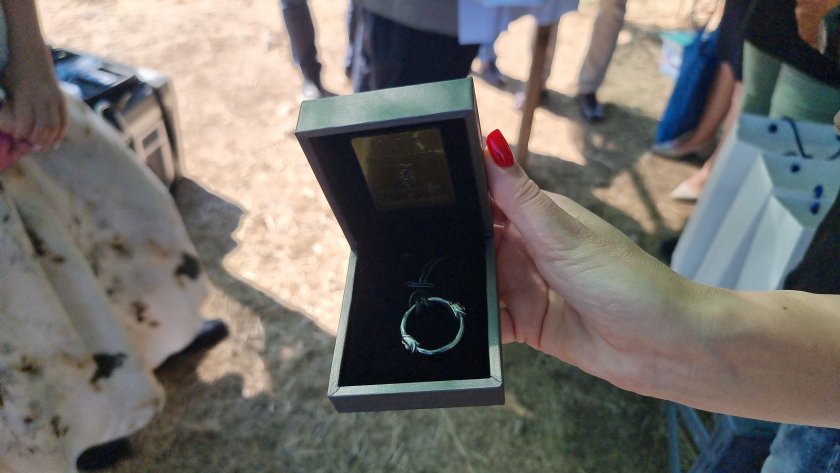
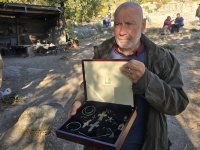
A women’s ring dating from the second half of the 14th century and depicting the Virgin Orans is the latest find from archaeological excavations at Kaliakra. This was announced to the media by Dr Filip Petrunov, one of the leaders of the archaeological research at the site and a researcher at the National Archaeological Institute with Museum at the Bulgarian Academy of Sciences.
The ring was discovered on Monday (10 August) and has the characteristic style of women’s rings from the second half of the 14th century. What makes the find particularly notable is the image on it, which was created using very shallow and simple incisions.
“The iconography itself is highly recognisable. Her gesture of blessing cannot be mistaken,” Dr Petrunov said.
According to him, the ring depicts the Virgin Orans, with the characteristic halo also included to emphasise her special status.
The archaeologists are yet to carry out laboratory treatment and microscopic analysis of the find. At this stage, specialists believe the image depicts the Virgin Mary, also taking into account the fact that the ring is a women’s ring.
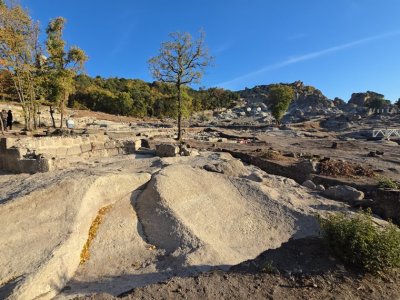
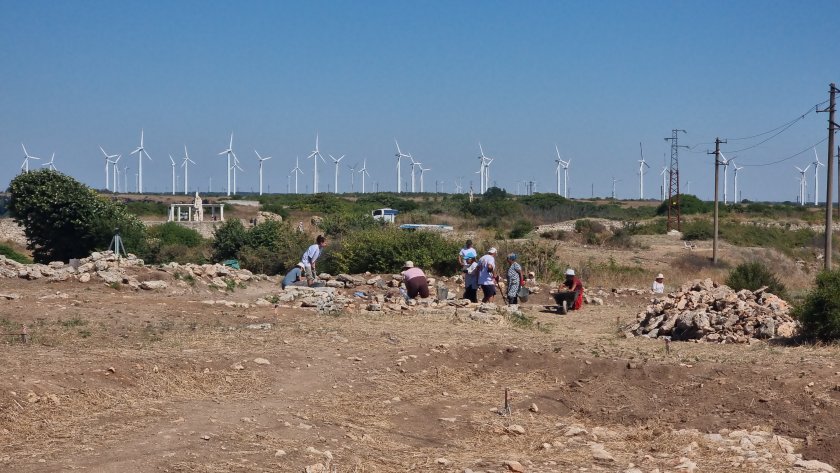
The new find is part of the rich archaeological material uncovered during excavations of the necropolis and residential quarter in the inner city of Kaliakra. More than 500 objects have been found over the past two archaeological seasons, Dr Petrunov said.
Among the finds dating from the second half of the 14th century are objects associated with the life and daily activities of the priests who served the churches of Kaliakra, as well as crosses, medallions, fragments of a stone icon depicting Jesus Christ Pantocrator and other artefacts.
More than 50 silver coins of various denominations have also been discovered during the current archaeological season. They include coins of Wallachian voivode Mircea I, Venetian coins and coins from the reign of Tsar Ivan Alexander. They are due to be cleaned and restored at the laboratory of the National History Museum, after which they will be identified.
According to Dr Filip Petrunov, the new finds support archaeologists’ hypothesis that the residential complex under investigation was a coenobitic complex – a type of communal dwelling in which both priests and lay people lived together.
The complex covers an area of more than 1,500 square metres and comprises more than 35 rooms arranged over several levels. Archaeologists estimate that between 200 and 250 people lived in this part of medieval Kaliakra alone.
The excavations have also revealed evidence of a military conflict at the end of the 14th century. The complex was burned down, while traces of the arrows used to attack the buildings have been preserved in some of the rooms.


 Latest Archaeological Finds at the Ancient Thracian City of Perperikon (see pics)
 The Most Outstanding Students from Raina Kabaivanska's Class Performed at the Sofia Opera
 Huge Interest Continues at Second 'Undercover' Season 6 Pre-Premiere Screening
 Гледайте първия епизод от новия, шести сезон на култовия сериал "Под прикритие" по БНТ










 Чуй новините
 Подкаст