

ИЗВЕСТИЯ

Моите новини

ЗАПАЗЕНИ

Bulgarian Astronomers Study Star with Magnetic Field Trillions of Times Stronger Than the Sun

bnt avatar logo от БНТ
A+ A-
Чете се за: 03:15 мин.

EN
български астрономи изследваха звезда магнитно поле трилиони силно слънцето
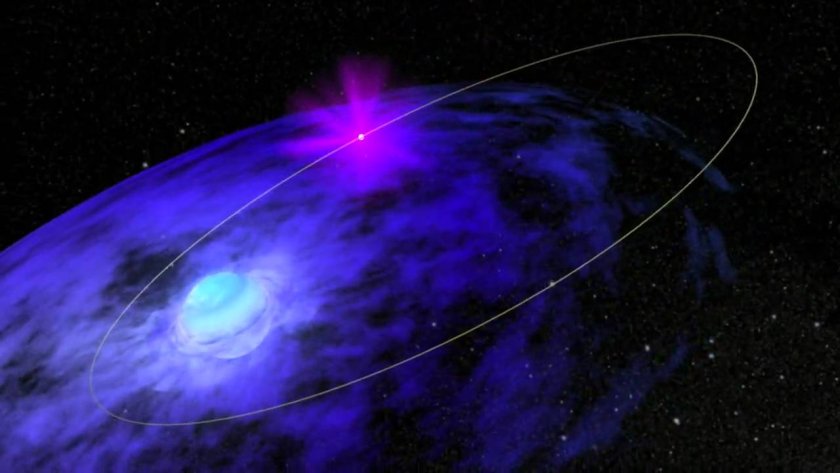
Снимка: Институт по астрономия с НАО - БАН

The study of the star 4U 2206+54,the magnetic field of which is trillions of times stronger than the Sun’s, has been recognised as the most significant scientific achievement of 2025 by the Institute of Astronomy at the National Astronomical Observatory (NAO) of the Bulgarian Academy of Sciences (BAS), the Institute said on January 26.

The results were obtained through observations with the 2-metre telescope at NAO – Rozhen and published in the prestigious journal Astronomy & Astrophysics. The research was conducted by an international team led by Associate Professor Dr Kiril Stoyanov. Team members include PhD student Miroslav Moiseev, Associate Professor Dr Yanko Nikolov, Professor Dr Radoslav Zamanov, Associate Professor Dr Georgi Latev from the Institute of Astronomy at NAO, as well as Dr Kristian Ilkievich from Poland and Dr Valeri Hambaryan from Armenia.

4U 2206+54 is a binary star system in the constellation Cepheus, consisting of a rapidly rotating O-type star with unusually high helium content and a neutron star with an exceptionally strong magnetic field. The system is among a rare group of candidates for a new class of objects known as accreting magnetars.

Magnetars are neutron stars with magnetic fields far stronger than typical neutron stars and are powerful sources of X-ray and gamma radiation.

Around 2.8 million years ago, 4U 2206+54 was ejected from the Cep OB1 stellar association following a supernova explosion that created the neutron star—a discovery published in 2022 with Bulgarian involvement.

Using spectroscopy and spectropolarimetry obtained entirely with the 2-metre Rozhen telescope, the team traced the structure and changes in the circumstellar disc that feeds the neutron star with matter. Measurements indicate that the radius of this disc is eight to fifteen times larger than the Sun’s radius.

The system provides crucial insights into the evolution of massive X-ray binaries, the mechanisms of accretion, and the influence of strong magnetic fields on processes in binary star systems, the Institute stated.

Source: BTA

Последвайте ни

ТОП 24

Най-четени

Product image
Новини Чуй новините Спорт На живо Аудио: На живо
Абонирай ме за най-важните новини?