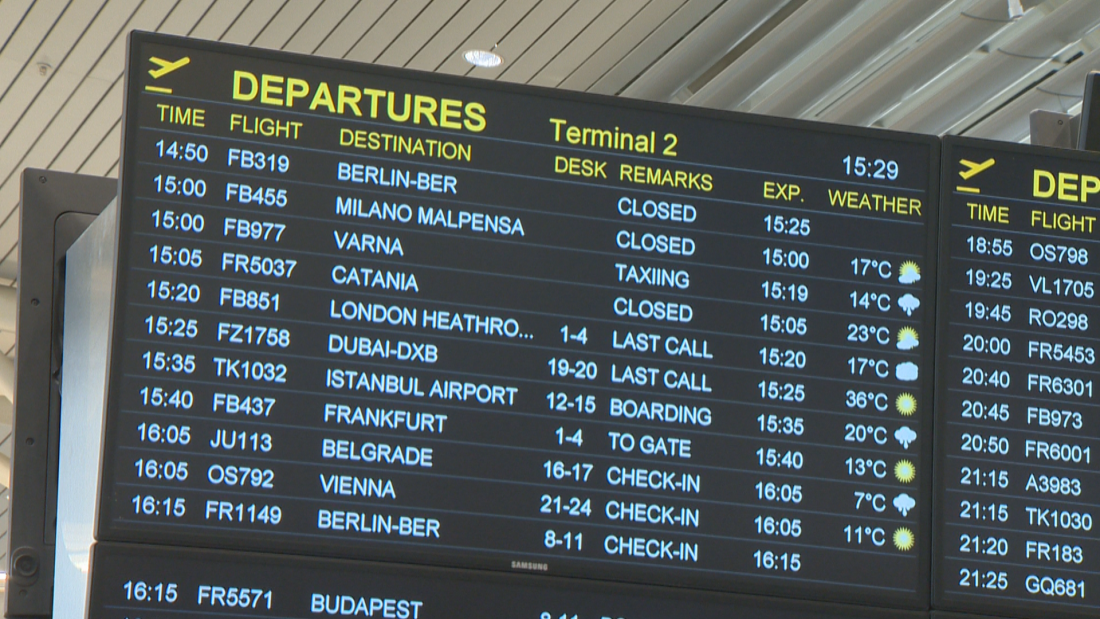
The Bulgarian aviation sector has reported an 8.1% increase in international passengers in 2025 compared with 2024, and traffic levels are 3.9% above the record year of 2019, according to the Association of Bulgarian Airlines.
Overall passenger numbers on commercial flights rose by 7.9% year-on-year, said the association’s chairman Yovko Yotsev at a press conference in Sofia presenting an analysis of market development and current sector challenges.
Sofia remains the dominant hub, handling nearly 70% of total passenger traffic. Sofia Airport recorded a 6.4% increase compared with 2024, with 89% of passengers travelling on scheduled services.
Varna Airport recorded a strong growth of over 36%, mainly driven by scheduled international flights. Burgas Airport saw a modest increase of around 2%.
Despite growth, both coastal airports remain below 2019 levels, with charter flights continuing to decline in favour of individual travel.
Yotsev noted that international scheduled traffic in 2025 is over 16% higher than in 2019 and more than 11% above 2024 levels. In contrast, numbers of charter flights are down, a trend attributed to changes in passenger behaviour and external factors such as uncertainty in the region.

A total of 13 airlines with valid air carrier licences operated in Bulgaria during 2025, with a combined fleet of 81 aircraft—including 60 passenger planes and 21 cargo aircraft, according to the Association of Bulgarian Airlines.
Chairman Yovko Yotsev said that Bulgarian carriers were active across a wide range of markets, including Europe, the Middle East, Asia, North America and Africa. A significant share of aircraft were deployed on foreign contracts, ensuring year-round utilisation.
He described 2025 as a generally favourable year for the aviation sector, despite challenges linked to rising operational costs and ongoing supply chain disruptions.
Globally, he noted a major slowdown in aircraft deliveries—around 5,000 aircraft delayed—which has forced airlines to extend the operational life of existing fleets. This has contributed to high utilisation levels, reaching around 74% in Europe.
Yotsev emphasised that Bulgaria operates in a highly competitive environment with full access to the European aviation market under equal regulatory conditions for all carriers.

Regarding infrastructure, he noted that the country has significant capacity for the maintenance and repair of aviation equipment, which exceeds several times the needs of Bulgaria’s own fleet.
The maintenance facilities are capable of servicing aircraft such as the Airbus A320 and Boeing 737, making the sector strongly export-oriented. Sofia is gradually establishing itself as a leading European centre in this field.
In the field of training, Yovko Yotsev noted that Bulgaria has a well-developed capacity for preparing aviation personnel, including pilots, cabin crew and engineering and technical staff, with existing simulator capacity exceeding the needs of the domestic market.
However, there is a shortage in initial flight training, mainly due to high costs and limited access to financing.
Among the key challenges facing the sector, he highlighted the high prices of aviation fuel and uncertainty regarding supply in certain regions. According to him, although no supply shortages are expected at Bulgarian airports, high prices are placing significant pressure on airlines.

Another significant challenge is the cost of carbon emissions. Yotsev noted that the price of emission allowances reaches around €75 per tonne, which increases costs by approximately €200 to €250 per tonne of fuel. Additional pressure is created by requirements for the use of sustainable aviation fuels, which are between three and seven times more expensive than conventional fuels and remain in limited supply, while the associated administrative reporting requirements are also substantial.
He also pointed to the geopolitical environment and airspace restrictions, which affect carriers’ routes and operating costs. In this context, Yocev noted that Bulgaria’s strategic location between Europe and Asia creates opportunities for the country to develop as a transit hub, but this would require a targeted state policy.
Source: BTA








 Чуй новините
 Подкаст