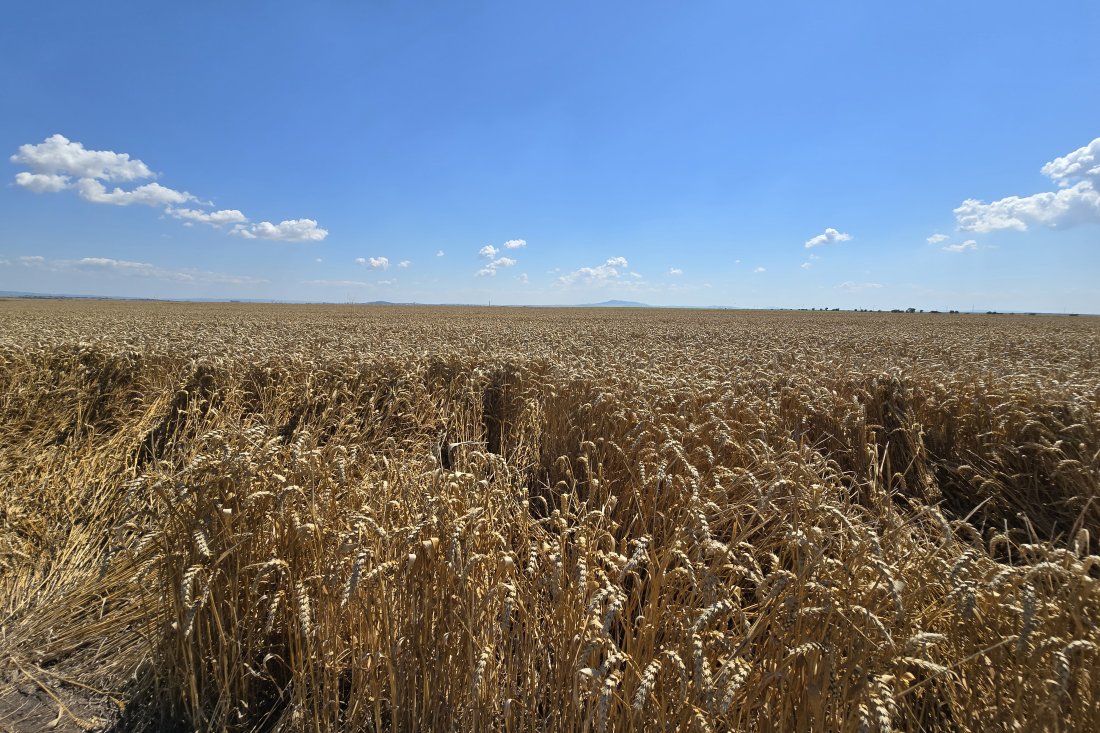
According to her, the main challenges facing producers at the moment are related not so much to the quality of the crop as to its sales and logistics:
Bulgaria has produced nearly 7 million tonnes of wheat this year, with the harvest 2.2% higher than in 2025. Quality is also good, although slightly lower protein levels were recorded at the beginning of the harvest. At the same time, logistical problems are making it harder to market the produce, with producers reporting lower exports compared with last year. Radostina Zhekova, chair of the Dobrudzha Union of Grain Producers, spoke about the wheat harvest, marketing opportunities and grain prices on “The Day Begins”.
According to her, the main difficulties currently facing producers are related less to the quality of the produce than to its marketing and logistics:
“What is happening in the rest of the world is not actually just about geopolitics. This time, it is mainly about logistics. Given that the Black Sea has become extremely risky – two months ago, if I remember correctly, statistics were released showing that 140 ships had sunk in the Black Sea, which automatically increases insurance costs for cargo entering and leaving the Black Sea,” the chair of the Dobrudzha Union of Grain Producers explained.
Another factor is the increase in transit fees through the Bosphorus and Dardanelles, as well as the lack of sufficient rail transport options in the country.
“Add to that Turkey, which increased the fees for crossing the Dardanelles by 15%. And the lack of rail transport – an issue repeatedly raised by the National Grain Producers Association – which is a convenient option in Bulgaria but, unfortunately, has simply been neglected over the past 30 years, makes the situation tremendously complicated,” Zhekova said.

Photo: BNT
She stressed that the problem is most acute for producers in central and western Bulgaria, for whom transporting produce to the Black Sea is considerably more expensive:
“It is genuinely extremely difficult there, and purely from a logistical perspective, it is an extremely costly resource to transport the produce from those areas to the Black Sea. As you know, the river near us is currently unnavigable due to insufficient water levels, so it is quite difficult logistically to make sales work,” she said.
As for exports, the latest official data show a decline compared with the previous year:
“The latest official statistics, released in July, showed that Bulgaria had exported around 500,000 tonnes less wheat than in 2025. What is encouraging is that wheat exports are now catching up, which means that traders have found a market where they can sell the produce.”
According to her, the situation surrounding exports from Ukraine and Russia is also affecting the ability of Bulgarian producers to market their produce.
Asked whether a good harvest and sufficient grain supplies should mean that bread prices remain stable, Zhekova said:
“Unfortunately, the price of wheat is not determined by production in Bulgaria. This is a global market, and prices are determined there. That is why there has also been a slight adjustment in wheat prices on the Bulgarian market.”
According to her, the price of wheat itself accounts for a relatively small share of the final price of bread:
“What is particularly important, however, is that the price of wheat is actually the smallest component of the cost of producing bread. And I am convinced that other factors are more likely to determine any potential increase in the price of bread.”

Photo: BGNES/Archive
Bulgaria has no problem securing wheat for the domestic market, Zhekova states categorically. The country produces significantly more than is needed for its own consumption:
"In fact, this year we’ve produced nearly 7 million metric tons of wheat, which we actually consume domestically, including for the livestock sector —by which I mean about 1 million plus 200,000 to 300,000 metric tons for animal feed. In other words, we have a surplus relative to our own consumption.”
Bulgaria has no problem securing wheat for the domestic market, Zhekova said. The country produces significantly more than it needs for domestic consumption:
“This year we have actually produced nearly 7 million tonnes of wheat, while domestic consumption, including the livestock sector – for feed, I mean – is around 1.2 to 1.3 million tonnes. In other words, we have an oversupply relative to our domestic consumption.”
According to her, a large proportion of the wheat produced remains in the country:
“In reality, we have exported no more than 1.2 million tonnes of wheat. Six million tonnes remain in our country. So there is absolutely no problem at the moment with buying wheat, building up stocks of wheat and buying Bulgarian wheat. This is not currently a problem for millers.”




 Български лекари ще прегледат Ива Михайлова, македонският външен министър: Разглеждаме това като жест на добра воля
 Специално за БНТ: Говори екипажът на хеликоптер от авиобаза „Крумово“ за мисията по издирване и спасяване в Черно море
 Илияна Йотова за КСНС: За първи път в български документ има три конкретни неща за войната в Украйна и последствията от нея










 Чуй новините
 Подкаст