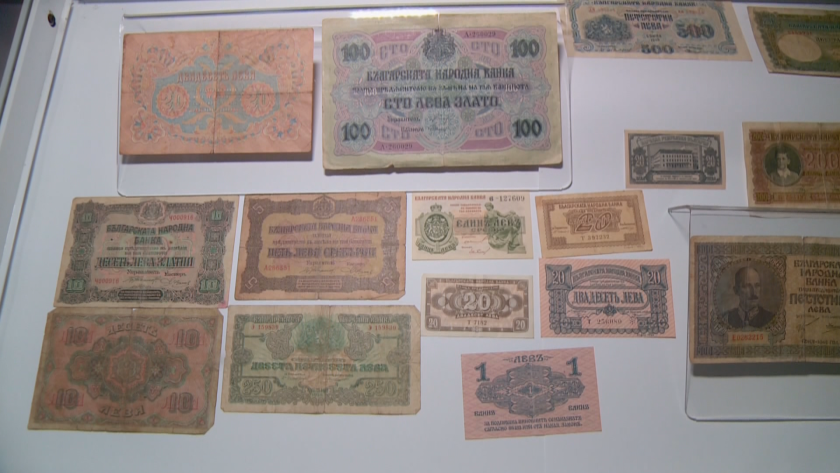
Bulgaria is on the verge of changing its currency, marking the end of an era for the lev. The first Bulgarian banknote, with a denomination of 20 leva, was printed on 1 August 1885 in Saint Petersburg. At the History Museum in the town of Perushtitsa, over 100 other original Bulgarian and European banknotes can be viewed. These come from the collection of the Regional Historiy Museum in Kyustendil and are featured in the exhibition "Stories of Paper Money."
The banknotes displayed in the Perushtitsa museum are original Bulgarian currency from the period spanning the Liberation to the Kingdom of Bulgaria. An interesting fact is that the first Bulgarian banknotes were backed by gold.
Dimitrina Pavlova, Director of the History Museum – Perushtitsa, explains: "You would go to the bank, give ten [leva], and they would give you the equivalent in gold, because merchants preferred to carry the paper rather than gold in their pockets."
The earliest Bulgarian banknotes had denominations of 20 and 50 leva. After the Liberation, they were printed in Russia, and later in Germany, England, and the United States.
Dimitrina Pavlova adds: “There were no printing houses here,” Pavlova continues. “After the Liberation, we practically had nothing—not even an administration. Everything had to start from scratch. We had no continuity, because under Ottoman rule we had lost our state. And so, once again, we had to issue money. With the first 100 leva, for example, one could travel to Paris.”
Some of the banknotes feature images of Paisiy Hilendarski (Saint Paisius of Hilendar), Ferdinand, the Bulgarian coat of arms, and the royal family.
Pavlova continues: "When Simeon - the heir to the throne of Boris the Third - was born, all the students graduated; there were no remedial exams, and all grades were inflated. We even have banknotes commemorating this."
The banknotes are also notable for their design, predominantly featuring the faces of prominent Bulgarians and animals.
“They reflect different stages of society’s development, changes in cultural and religious life, and the state of the economy,” Pavlova notes. “We are generally less familiar with banknotes, which is why this exhibition is particularly compelling—especially at a time when we are about to part with the lev. The lev is more than just a currency; it is a symbol of identity.”
The exhibition also features paper money from other Balkan countries, as well as Germany, France, and the Ottoman Empire.
“After the First World War, during hyperinflation, there is even a photo showing a German woman using banknotes to light her stove, as they had become worthless. One needed an entire suitcase just to buy a loaf of bread,” Pavlova recounts.
In Russia, for example, rubles were originally exchanged for copper coins.
Dimitrina Pavlova, director of the Perushchitsa History Museum: “Banknotes were printed on whatever was available. One side could be a label, and the other a banknote,” she explains.
Rumen Ivanov, an archaeologist at the museum, said: “After the Liberation, some of the banknotes had to be printed abroad, as Bulgaria did not yet have a printing house for them. Some were printed in Western Europe. They featured Arabic calligraphy but without human or animal images - reflecting Islamic traditions. The exhibition will be open until mid-January next year.”


 "Това е победа на смелостта над страха": Студентите в Сърбия ликуват след триумфа на изборите








 Чуй новините
 Подкаст