

ИЗВЕСТИЯ

Моите новини

ЗАПАЗЕНИ

Over 60% of Bulgarians Fear Lack of New Budget Will Affect Living Standards, Survey Shows

bnt avatar logo от БНТ
A+ A-
Чете се за: 08:02 мин.
EN
мяра липсата нов бюджет отрази реално жизнения стандарт нас българите
Снимка: Archive/BTA

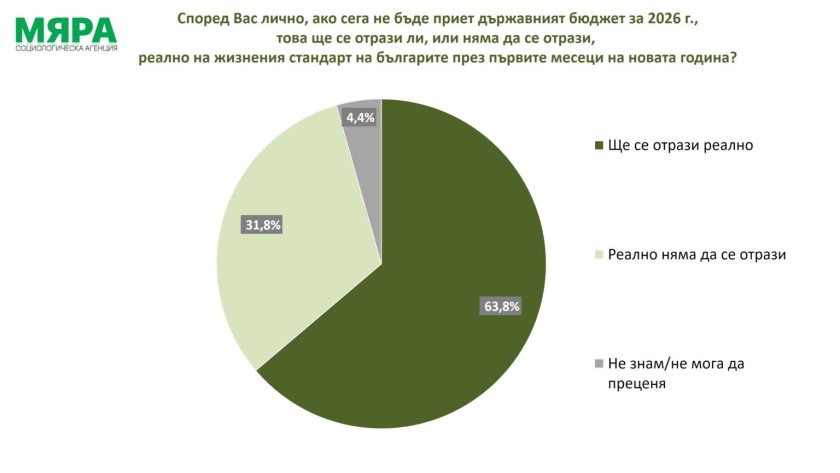
Nearly two-thirds of Bulgarians fear that the absence of a new state budget will have a real impact on living standards in the country. This is according to data from a survey conducted by the polling agency Myara. A total of 31.8% of respondents hold the opposite view, while a small “grey zone” of 4.4% say they are unable to judge. The survey was conducted among 802 adult Bulgarians between 15 and 17 December.

The findings come against the backdrop of a lower willingness among Bulgarians to spend during the holiday season.

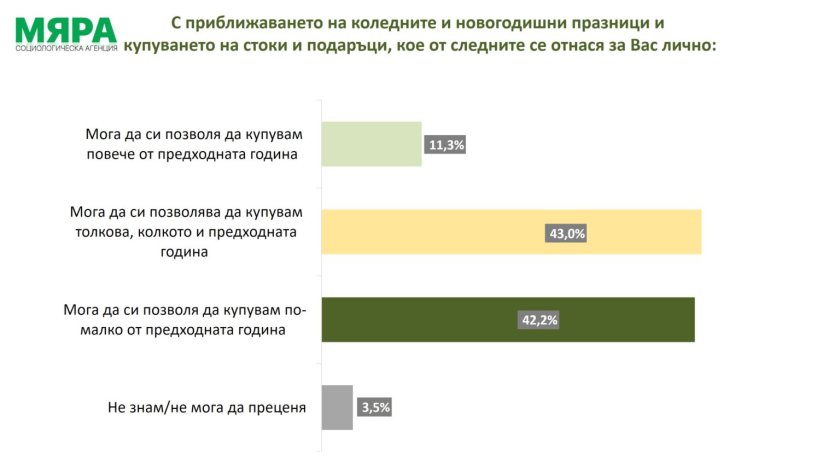
As the Christmas and New Year holidays approach—a period typically associated with increased consumer spending—43% of respondents say there has been no change in their purchasing power compared to the previous year. However, 42.2% report that their ability to buy goods and gifts has declined. Slightly more than one tenth assess their financial situation around the holidays as better than last year, while the remainder are unable to judge.

Generational divides are visible. The youngest respondents and those of working age are the groups most likely to say they have maintained their purchasing power. Among older people, purchasing power has declined to the greatest extent. Overall, according to Bulgarians’ own assessments, this year they can afford roughly the same as last year—or less.

As for responsibility for the budget impasse, 53.9% say all political parties are to blame. Another 33.5% believe responsibility lies with the outgoing governing parties, while 8.2% say the opposition is to blame for the failure to adopt a budget. Public sentiment points to concern over the lack of an approved budget, with society attributing responsibility to everyone, but most visibly to the outgoing authorities.

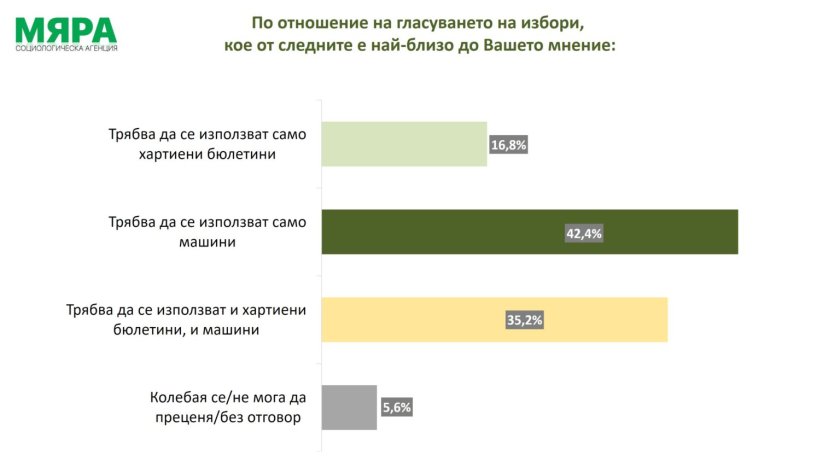
There is also broad support for changes to electoral legislation ahead of any new elections. Almost automatically, the idea is accepted by 74% of respondents, while 22.6% disagree. When it comes to voting methods, 42.4% say voting should be conducted exclusively by machines, 35.2% support a mixed system of machine and paper ballots, and 16.8% prefer paper ballots only. The remaining respondents are undecided. Asked to choose one option if required, 59.4% opt for machine voting, while 28.7% choose paper ballots.

The data come from an independent telephone survey conducted by the polling agency 'Myara' between 15 and 17 December 2025 among 802 adult Bulgarian citizens. The maximum standard sampling error is ±3.5 percentage points at a 50% share. One per cent of the sample corresponds to approximately 54,000 people.

The data come from an independent survey conducted by the Myara polling agency. The survey represents the views of the country’s adult population and was carried out between 15 and 17 December among 802 adult Bulgarians. Such surveys are primarily used for rapid observations, to assess the general structure of public opinion and to formulate hypotheses for subsequent, more in-depth research.

According to 53.9% of respondents, responsibility for the budget impasse lies with all political parties. A further 33.5% believe it is the responsibility of the outgoing authorities, while 8.2% say the blame for the failure to adopt a budget rests with the opposition.

The findings come against the backdrop of a lower willingness among Bulgarians to spend during the holiday season, analysts note. As Christmas and New Year approach—a period typically associated with increased consumer spending—43% of respondents say there has been no change in their purchasing power compared to the previous year. Meanwhile, 42.2% report that their ability to buy goods and gifts has declined. Slightly more than one tenth assess their financial situation around the holidays as better than last year, while the rest are unable to judge.

Around ten per cent of Bulgarians say they can afford to buy more goods and gifts for Christmas and New Year this year compared to last year. The remainder are evenly split between those who say they can afford about the same as last year and those who say they can afford less, according to Myara.

The youngest respondents and those of working age are most likely to say they have maintained their purchasing power. Among older people, purchasing power has declined to the greatest extent. Overall, based on Bulgarians’ own assessments, this year they can afford roughly the same as last year—or less, analysts conclude.

The survey also shows strong support for changes to electoral legislation ahead of any new elections. A total of 74% agree that the electoral law should be amended before the next vote, while 22.6% disagree. According to 42.4% of respondents, voting should be conducted exclusively by machines; 35.2% support a mixed system combining machine and paper voting, while 16.8% prefer paper ballots only. Asked to choose one option if required, 59.4% opt for machine voting and 28.7% for paper ballots.

Последвайте ни

ТОП 24

Най-четени

Водещи новини

Product image
Новини Чуй новините Спорт На живо Аудио: На живо
Абонирай ме за най-важните новини?