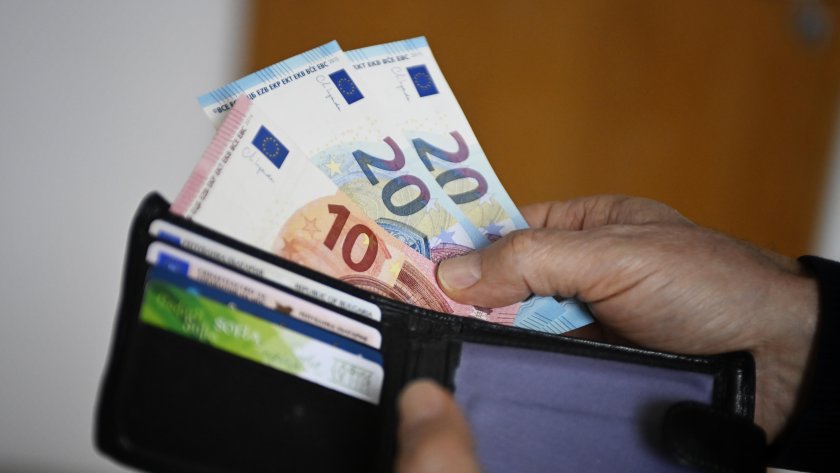
Bulgaria has now been using the euro exclusively for two days. In the Personal Finance segment, Svetozar Kostadinov highlights key and lesser-known facts about Bulgaria’s official currency.
How can genuine euro banknotes be distinguished from counterfeits?
Euro banknotes are among the most technologically advanced in the world when it comes to protection against counterfeiting. Each denomination has a different size and colour, and most feature tactile elements designed to help people with visual impairments. The notes incorporate multiple security features, ranging from clearly visible elements such as holograms and watermarks to more subtle details like microprinting. Some security features are visible only under ultraviolet light and cannot be seen with the naked eye.
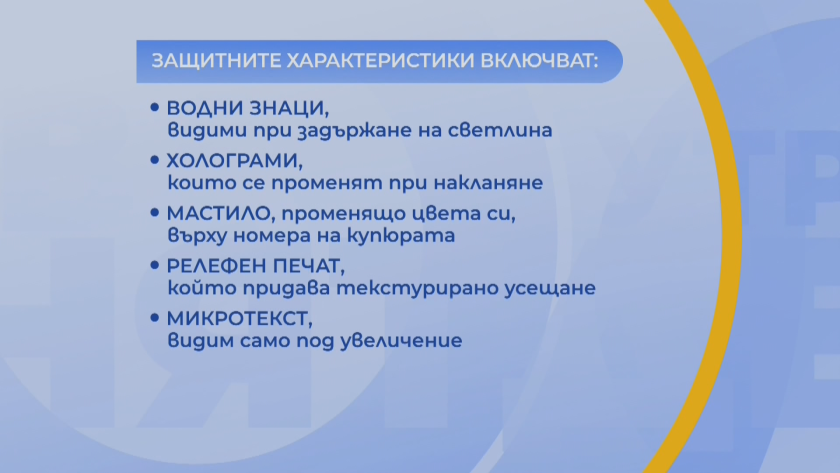
Key security features include:
- Watermarks visible when held up to the light
- Holograms that change appearance when tilted
- Colour-shifting ink on the denomination number
- Raised printing that gives the surface a textured feel
- Microtext, readable only under magnification
The effectiveness of these measures is reflected in counterfeiting statistics. Following the introduction of the “Europa” series in 2013, the number of counterfeit euro banknotes detected each year fell significantly. In 2013, around 670,000 fake notes were withdrawn from circulation. By 2021, that figure had dropped to approximately 368,000.
The proportion of counterfeit notes in circulation remains very low and is currently at a record level. In 2020, just 17 out of every one million banknotes were identified as counterfeit — one of the best ratios among major global currencies.
The euro was introduced in an unstable environment — what was its economic impact?
The euro symbol (€) was designed in the 1990s to be simple, recognisable and meaningful. It is based on the Greek letter epsilon (Є), a reference to the first letter of the word “Europe”. The two horizontal lines symbolise stability. Today, it is one of the most recognisable symbols in the world.
The introduction of the euro had a significant impact on the economies of member states, promoting economic integration and stability. The single currency facilitated easier and more efficient cross-border trade, reduced currency exchange costs and eliminated exchange rate uncertainty.
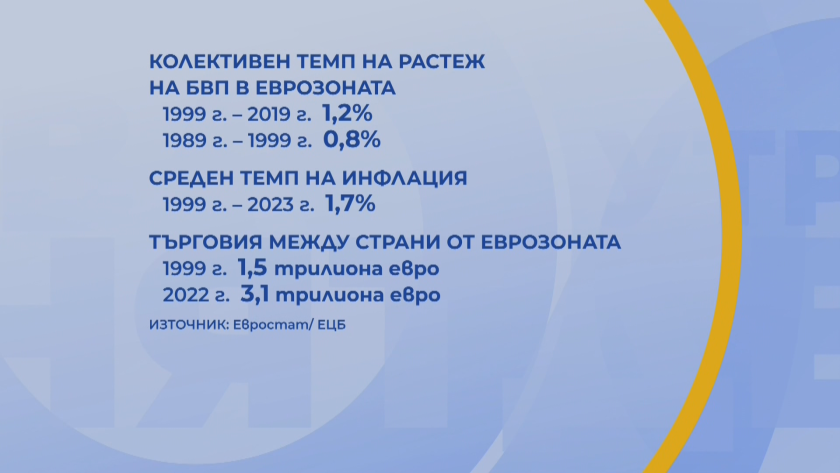
As a result, the eurozone recorded an average annual GDP growth rate of around 1.2% between 1999 and 2019, compared with 0.8% in the decade before the euro’s introduction. Inflation also became more stable, averaging around 1.7% between 1999 and 2023, compared with higher and more volatile rates prior to the euro era.
Trade data further illustrates the euro’s impact. Trade within the eurozone increased markedly, with the value of goods exchanged between member states rising from around €1.5 trillion in 1999 to more than €3.1 trillion in 2022.
This growth underlines the euro’s role in strengthening economic cooperation and enhancing the competitiveness of eurozone economies on the global stage. Overall, the euro has played a key role in promoting economic stability and growth among member states, contributing to a more integrated and resilient European economy.
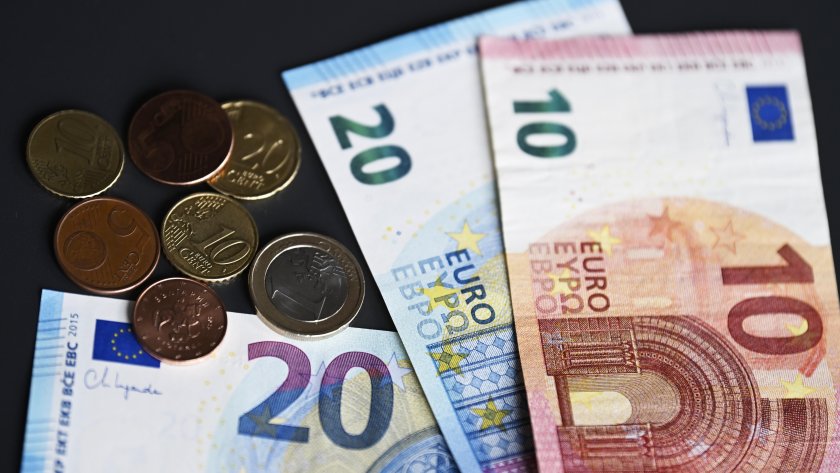
The first discussions about a common European currency date back to the 1960s, during meetings of the European Economic Community, which explored the idea of economic and monetary union. It was not until the Maastricht Treaty of 1992 that member states agreed on a formal framework for a single currency system.
The name “euro” was officially adopted at a European Council meeting in Madrid on 15–16 December 1995. The euro was first introduced on 1 January 1999 as a currency for electronic payments, without physical notes or coins. These entered circulation three years later, on 1 January 2002. The founding group consisted of 11 countries, later joined by Greece.
The launch of the euro was a vast logistical operation. Within weeks, 15 billion banknotes and 52 billion coins were put into circulation under the strictest security conditions. Seven euro denominations replaced 12 national currencies. At the same time, the public had to be educated about the new notes and their security features, such as holograms and watermarks.
How is the euro viewed in countries that have used it for longer?
Over the past 20 years, support for the euro among citizens of the eurozone has remained consistently high. In 2025, backing for the single currency reached record levels, with a historic peak of 83% of eurozone citizens expressing support.
This reflects strong European integration and the tangible benefits of the euro, while Eurostat data showing stable inflation and forecasting continued GDP growth have further strengthened confidence in the currency’s stability and the region’s economic future.
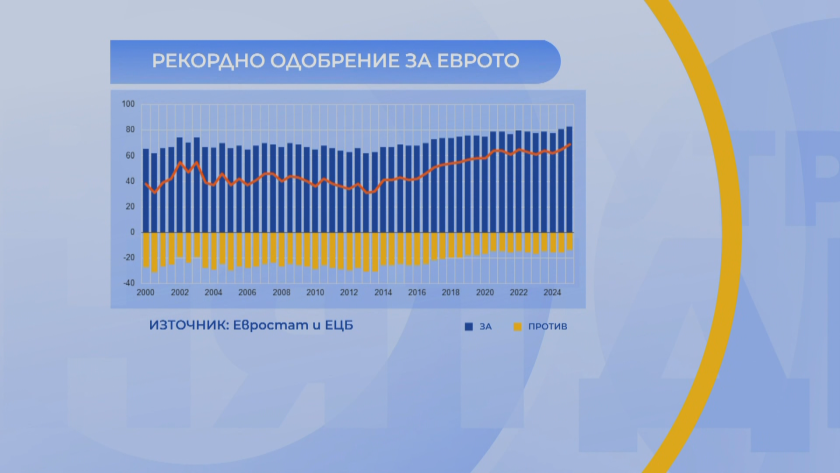
Eurostat data show stable annual inflation of around 2% and forecast continued growth in real GDP across the eurozone, signalling a healthy economic environment.
Citizens see the euro as a symbol of integration and place growing trust in its benefits, although concerns about the cost of living and security persist, prompting calls for further action at EU level.








 Чуй новините
 Подкаст