It is kept in the History Museum in the city of Gabrovo (Central Bulgaria)
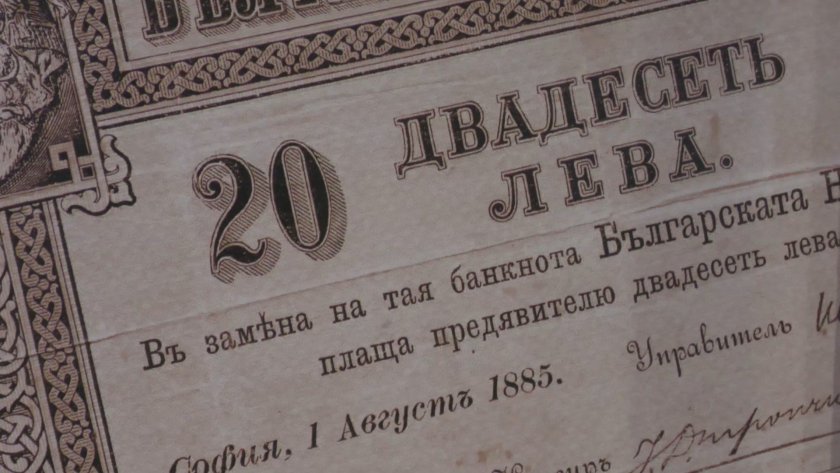
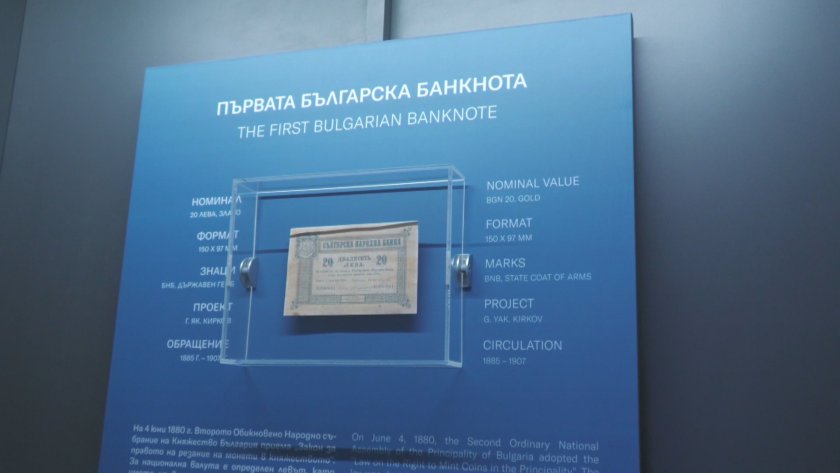
In the days when Bulgaria has officially adopted the euro and the lev is becoming part of history, we take a look at the first Bulgarian banknote, issued on 1 August 1885.
It is preserved at the Regional History Museum in the city of Gabrovo.
Its denomination is 20 leva and it was printed 140 years ago at the State Printing House in Saint Petersburg.
How did it end up in Gabrovo and what is the story of Bulgaria’s first banknotes?
More than a century ago, Bulgaria took its first step towards financial independence. By law, the state granted the Bulgarian National Bank the right to issue paper money.
Thus, the first Bulgarian banknote came into existence.
What will be the collectors’ value of the lev today?

Rossen Yosifov, Director of the Regional History Museum – Gabrovo:
“These were the first Bulgarian paper banknotes. In that year, two denominations were issued – 20 leva and 50 leva in gold. They were backed by gold until the First World War. The bearer had the right to receive one third of their value in gold directly from the bank. The lev was therefore convertible throughout Europe.”
The first series was printed in an extremely small circulation – just 213,000 leva.
Even today, one of these banknotes is preserved as a true treasure.
Rossen Yosifov, Director of the Regional History Museum – Gabrovo:
“They remained in circulation until 1907. Here at the Regional Historical Museum in Gabrovo, we preserve a truly unique cultural asset. This is a banknote with serial number 00001.”
Its story is almost like a novel.
Discovered and preserved by a merchant from Gabrovo, it passed through several generations before finally reaching the museum.
“The Tyulenbakov brothers were merchants who, as early as the National Revival period, conducted trade with Romania. Vasil Tyulenbakov, after taking part in various public initiatives, was involved in 1897 in the transfer of the remains of Vasil Aprilov from Galati, where he had died and been buried, to Gabrovo, where they remain to this day. It was around this event, in Romania, that this banknote came into his possession. It must have impressed him, because it was never folded and shows no signs of heavy use. It remained with him and was later passed on to his son, Hristo Tyulenbakov, an educated man, an engineer and a teacher at the Aprilov High School. In 1962, the banknote was sold to what was then the District Historical Museum for 250 leva.”

The first banknote was printed at the State Printing House of the Russian Empire in Saint Petersburg, and its design was simple.
Rossen Yosifov, Director of the Regional History Museum – Gabrovo:
“There are no images on it. The first known banknote designer applied a minimalist design, without illustrations, mainly using geometric elements in a light brown colour palette. Of course, there is also a warning that anyone guilty of counterfeiting would be punished in accordance with the law.”
Even back then, the question arose of what Bulgaria’s currency should be called – a debate that sounds strikingly relevant today.
“Stefan Stambolov proposed that it should be called the franc, subdivided into centimes, so that it would be recognisable throughout Europe. There are even Bulgarian coins called centimes, which are extremely rare today. When he later became Prime Minister, he again returned to this idea – that the Bulgarian currency should be francs and centimes, not the lev, precisely so that it would be easily recognised across Europe. So this debate has existed for a very long time.”
Today, more than a century later, this path ends with the adoption of the euro.
“At the end of January, on 28 January, we will open a major exhibition entitled ‘When the Lev Becomes History’. We will present the wealth of items we preserve and focus on the development of the financial system and the difficulties faced by the Bulgarian state. It must be said that in all periods Bulgaria has experienced serious financial challenges, not only today. I hope this exhibition will generate great interest.”
From a gold-backed lev to the common European currency – history comes full circle while also opening a new chapter. And the first Bulgarian banknote remains here to remind us where we began, and why money always tells a story that goes far beyond mere numbers.


 ЦИК при обработени 17,86% СИК протоколи: Йотова и Гюров отиват на балотаж на 1 ноември (ОБНОВЯВА СЕ)
 Историческа победа за студентите, Вучич призна загубата си на парламентарните избори в Сърбия










 Чуй новините
 Подкаст