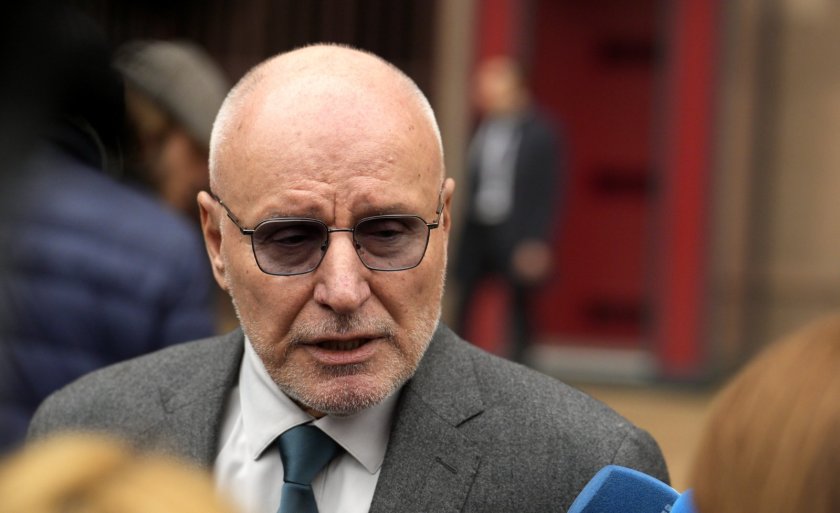
Discipline, preparation and trust are the three factors that contributed to Bulgaria’s successful adoption of the euro, said Dimitar Radev at an event organised by the Atlantic Council during the Spring Meetings of the International Monetary Fund and the World Bank in Washington.
“For Bulgaria, adopting the euro was not a last-minute decision. It was the natural culmination of a long process. I am talking about decades, not years. And the main lesson from our experience is this: you do not adopt the euro in order to gain trust. You adopt it when you already have trust. Or, put differently, the euro does not create trust—it reinforces it,” Radev said.
The currency board, in place in Bulgaria for nearly 30 years, has helped instil discipline not only in monetary policy but also in fiscal policy, reflected in one of the lowest public debt-to-GDP ratios in Europe. Bulgaria’s time spent in the ERM II and the EU Banking Union also made a significant contribution to the country’s preparation for joining the monetary union, he added.
“This helped us align policies, build capacity and strengthen trust. And when the moment for transition came, the process worked,” Radev noted.
According to him, trust is crucial, as without public confidence the process cannot function. This is why the focus has been on transparency and safeguards despite the country’s complex political situation. He pointed to encouraging signs, including the limited impact of euro adoption on inflation and growing public support for the single currency.
The euro was originally conceived as a currency for the European Union rather than a global currency. Recently, however, there have been increasing calls from other parts of the world for the euro to take on a stronger international role, said Martin Kocher, who was elected Governor of the Austrian National Bank in 2025.
He noted that enlargement has always been important for the euro area, and that more EU Member States are expected to become candidates for joining the monetary union in the coming years.
This process is linked to the growing volume of international payments, as well as to geopolitical considerations and the success of the euro. Most importantly, however, the European Central Bank must continue to fulfil its mandate and serve as a model of independence, Kocher stressed.
Following the historic elections in Hungary, the winners—led by future Prime Minister Péter Magyar—have declared the slogan “Back to Europe” as central to their policy agenda, said Piroska Nagy-Mohácsi, a lecturer at the London School of Economics.
In Hungary, public support for adopting the euro has consistently been very high—close to 80 per cent, second only to Romania. However, a decisive political commitment will be required to set and support the achievement of this goal at the appropriate time, Nagy-Mohácsi said.
Attitudes towards the euro are also shifting in Sweden, noted former Governor of the Swedish central bank, Stefan Ingves.
When the euro area was created, Sweden decided in 1999 not to join, and in 2003 rejected the euro in a referendum. The country follows a similar model of macroeconomic and fiscal indicators to those of the euro area and could meet the accession criteria.
At the same time, developments in modern finance make it impossible for a small open economy to independently build all the systems needed to fully participate in these processes, Ingves said.
“In practice, you have to choose your partners. And the best partner, if you are a small central bank, is to join and work with the European Central Bank, which has the resources to build these systems,” the former Riksbank head said.
According to him, the question of political debate in Sweden remains open.
“In my view, it has not yet matured, but there is a growing recognition that the world has changed and that geopolitics today is entirely different compared with 25–30 years ago,” Ingves noted.
In terms of working with public opinion and political debate, Radev highlighted another key aspect of Bulgaria’s experience—close cooperation with business associations, universities and non-governmental organisations.
“This helped explain the processes and, through their platforms, reach a wider audience,” Dimitar Radev said.
Source: BTA






 Чуй новините
 Подкаст