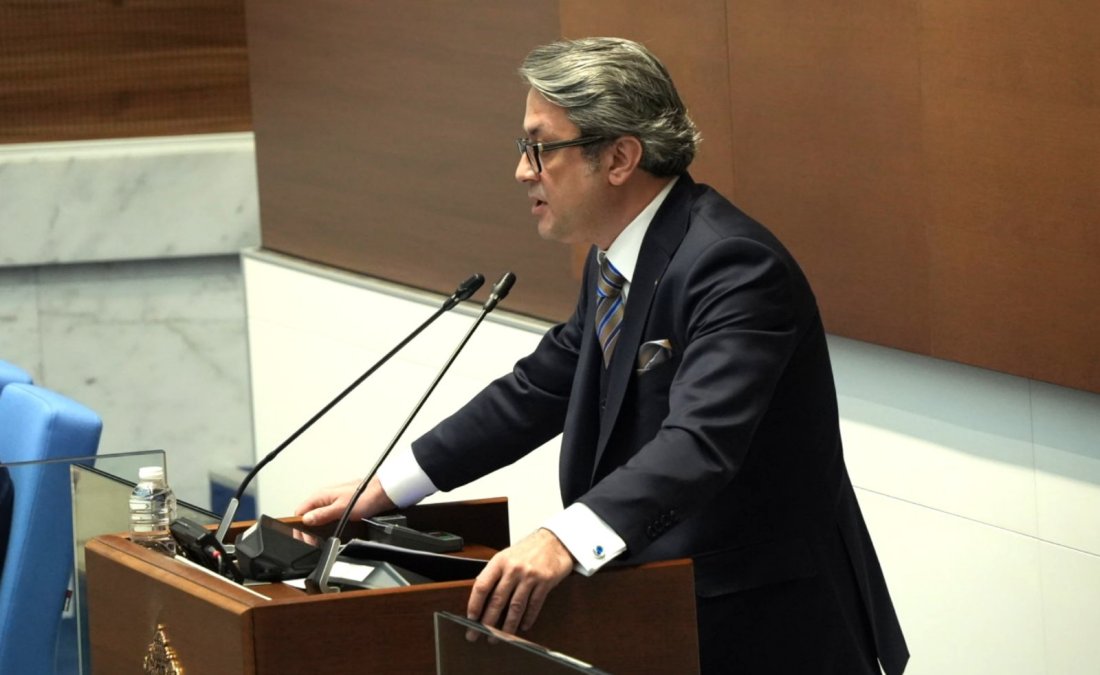
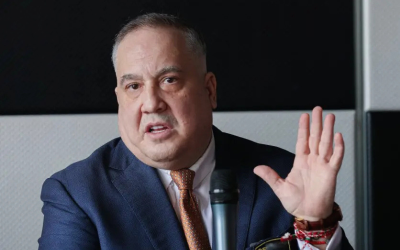
“We will support a representative of ‘Progressive Bulgaria’ for Speaker of the 52nd National Assembly. This should not be interpreted either as an attempt at a deal or as any particular political signal, but as an effort to restore a somewhat forgotten parliamentary tradition and an opportunity to establish a higher political standard in this Parliament.
According to him, a higher political standard does not exclude debate; on the contrary, it implies the obligation of the opposition to represent citizens who hold views different from those of the parliamentary majority and to ensure their right to express them freely and loudly.
“In this Parliament, this will be our main task, and we believe we will fulfil it in the best possible way,” he added.
Earlier today, April 30, the oldest MP present, Rumen Milanov of “Progressive Bulgaria”, opened the first sitting of the newly elected 52nd National Assembly. The new MPs then took their oath of office.
Over the past 12 years, Bulgaria has been governed by coalition governments, and in the last five years the country has fallen into a chronic political crisis and an inability of parliamentary forces to produce stable governance. This has happened despite the need for stable decisions in an unstable geopolitical environment, the need for reforms across multiple public systems, and against the backdrop of a fiscal policy that has treated budget deficits as normal, said Toma Bikov.
“In recent years, we have called for raising the level of political debate and have warned that personal attacks and scandals erode trust in the entire political system and its institutions,” he added.
At the recent elections, a large majority decided to bring an end to the political process in its fragmented coalition form and to grant a full mandate to “Progressive Bulgaria”.
The GERB–UDF parliamentary group accepts this result and, following its logic, is ready to serve as a right-wing conservative, constructive, meaningful and strong opposition, defending the national interest and the interests of its voters, and exercising systematic parliamentary oversight over the majority.
The election result clearly shows that citizens are not giving a mandate solely to “Progressive Bulgaria” to govern, but a broad mandate for deep structural reforms, the scope of which is not limited to judicial reform alone, but extends to the reform of numerous institutions, systems and social relations.
According to him, a large majority of citizens voted not for “Progressive Bulgaria”, but personally for Rumen Radev. From today, he will have all the instruments of the state to fulfil the expectations of a large part of society, without having to take into account coalition partners or any external constraints. This is a major responsibility requiring swift and precise action, which from today depends on Radev’s will, Bikov said.
He added that in recent years the GERB–UDF parliamentary group had called for the preservation of political dialogue and, in the name of stability and their desire for stable governance, had made a number of compromises and often deviated from the authentic will of their voters.
According to Bikov, coalition governments involving GERB–UDF have brought a number of negative consequences. He added that the inability to form regular governments in several parliaments had also had a negative impact, which was clearly reflected in their result at the last elections.
“Today we are convinced that, in a situation of political crisis and a fragmented Parliament, political dialogue — even with our main opponents — was a necessity that many parties failed to recognise.
We are aware both of the compromises we made and of their consequences, and therefore we thank the voters who supported us,” he added.
“We declare that in the 52nd National Assembly, the GERB–UDF parliamentary group will support only decisions that correspond to our electoral programme and reflect the will of our voters.
In the new realities — under the full majority of Radev — conducting political dialogue is no longer a necessity,” Bikov said.
He added that such dialogue could now take place only if the governing majority wishes to engage in it. According to him, structural reforms are now essential, and any delay or failure to implement them will lead to public disappointment.
“If this necessity is not recognised and does not result in concrete political action by the authorities, the outcome will be similar to that of the unrecognised need for quality political dialogue over the past five years. Such a development would lead to new shocks in the political system and across sectors of public life,” he said.
Bikov recalled that there has not been a full parliamentary majority in Bulgaria since the victory of the Union of Democratic Forces (UDF) in 1997, but clarified that this majority had emerged to replace the failed reformist majority of the Bulgarian Socialist Party in 1994.
“This is an instructive fact which shows that there is no parliamentary majority capable of eliminating the challenges of the time or replacing the need for a reform-oriented government,” he said.
According to him, from this perspective, the dilemma facing the full majority of “Progressive Bulgaria” today is either unpopular reforms with a right-wing profile or failure.
He added that within this session alone, the 2026 budget is expected to be adopted, and that the actions of the governing majority in this process will show whether they are prepared for the enormous responsibility they bear.
“We hope that with the adoption of this year’s budget, a course will be set towards fiscal consolidation, a systematic reduction of the budget deficit, and the introduction of structural reforms across a number of sectors,” he said.
“And even after these elections, the challenges arising from the disintegrating international order, the technological revolution and the fragmentation of Bulgarian society will remain valid. These challenges do not allow for euphoria, but instead require a deeper reflection on Bulgaria’s direction,” Bikov added.
In this context, GERB–UDF will be an active part of political debate in its substantive form, while continuing to refrain from the use of personal qualifications, insults and the reduction of parliamentary work to the level of scandal.
“In the name of the public interest, we expect the same from the other parliamentary groups,” Bikov said.







 Чуй новините
 Подкаст