In recent days, the Black Sea has a turquoise blue colour. The rare phenomenon is observed all over the coast.
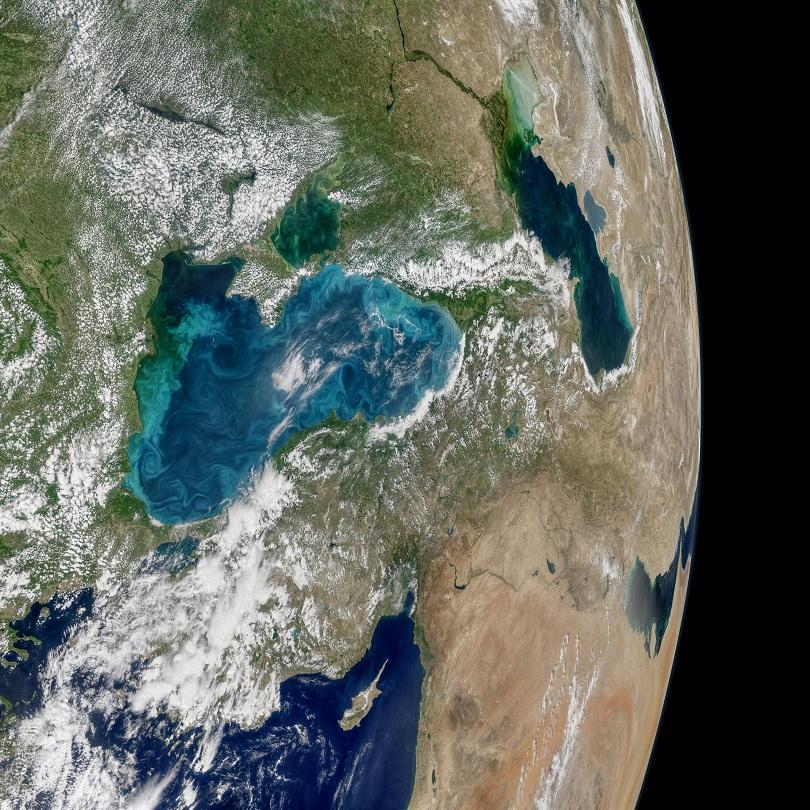
In the recent days, the Black Sea has a turquoise blue colour. The rare phenomenon is observed all over the coast. The experts from the Institute of Oceanology in the Bulgarian coastal city of Varna say that this is due to the bloom of a certain type of phytoplankton.
Fishermen, who often see different natural phenomena, believe that this is the usual colour for the sea at the beginning of summer.
The colour of the sea often changes, old fishermen say.
The Black Sea water has had turquoise blue colour in some places for the past few days and attracts the attention of residents and tourists. Many take pictures of the turquoise sea. Experts say this beautiful colour is not unusual for the season.
Prof. Valentina Todorova from the Institute of Oceanology says that it happens every year in the late spring, end of May and in June, and this milky turquoise blue colour is due to algal blooms of sea weeds from the class of cocolitophores and more precisely of the species Emiliania huxleyi . Samples were taken and they confirmed the bloom of this species, " she explained.
Emiliania huxleyi is a type of phytoplankton that occurs in almost all seas and oceans. It is plated with calcium carbonate, which reflect the light and thus influence the climate.
"The formation of a compound - dimethyl sulphite, which is volatile, emits itself into the atmosphere and this compound is the nucleus for formation of clouds in the atmosphere." When more clouds form, then the reflection capacity of the planet increases, i.e. most of the solar radiation returns. "
The phytoplankton Emiliania huxleyi, which is the cause of the turquoise sea, is not toxic and does not pose a threat to tourists. For lovers of sea adventure, specialists recall that by the end of August there will be a blooming of another plankton - phosphorescent.
On 13th of June, the US space agency NASA published photos of the turquoise blue Black Sea. The photo is called "Turquoise Swirls in the Black Sea" captured on May 29 by NASA’s Aqua satellite. The image is a mosaic, composed from multiple satellite passes over the region. It shows phytoplankton swirling in the currents of the Black Sea.
NASA explains that the turquoise swirls are not the brushstrokes of a painting; they indicate the presence of phytoplankton.


 President Iliana Iotova's Flight Diverted to Boston Due to Temporary Closure of Airports in New York
 Foreign Minister Met With Long-Standing Co-Chair of Congressional Bulgaria Caucus in the U.S. House of Representatives
 Central Election Commission Receives Registration Documents for 24 Presidential Tickets
 The Fire Between Veliko Tarnovo and the village of Belyakovets Has Been Contained
 Ново заседание за смъртта на 14-годишния Филип, който загина на пешеходна пътека
 Как ще се гласува в чужбина? МВнР с подробности за организацията на вота
 Кабинетът решава при какви условия ще се отпускат безлихвени заеми на общините









 Чуй новините
 Подкаст