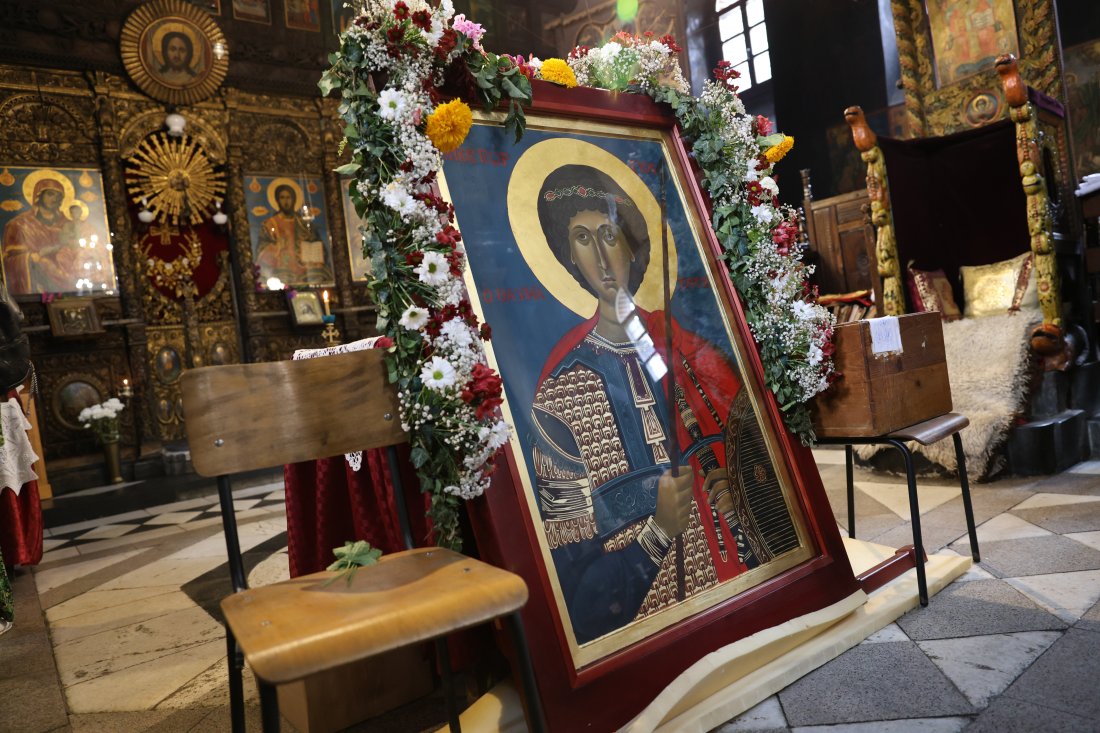
On 6th of May, Bulgaria celebrates the Day of Saint George the Victorious.
The public holiday is also known as Gergyovden and is one of the most celebrated name-days in the country.
According to tradition, he was a Roman soldier and a Christian. He was born in Cappadocia (modern-day Turkey) into a Christian family. His father served as an officer in the Roman army, while his mother was from Lydda in Palestine, where she returned as a widow with her young son. The young George followed in his father’s footsteps and entered military service, where he proved himself a capable soldier and rose quickly through the ranks. At that time, he served in the personal guard of Emperor Diocletian, who issued an edict for the systematic persecution of Christians throughout the empire.
George was ordered to take part in these persecutions, but instead he openly declared himself a Christian and criticised the emperor’s decision. Enraged, Diocletian ordered that George be tortured and executed as a traitor. His body was buried in Lydda. Soon after, Christians began to venerate him as a martyr, owing to the many miracles attributed to him after his death, as a heavenly warrior and protector.
One of the most famous miracles associated with Saint George—and the reason he is often depicted in icons slaying a dragon—took place near the city of Berytus (modern-day Beirut), not far from Lydda, where the saint’s body lay. Near the city there was a large lake inhabited by a fearsome dragon. It would frequently emerge, claiming many victims. When it approached the city walls, its breath would poison those nearby. The townspeople tried repeatedly to defeat the beast, but without success. Eventually, they appealed to their ruler, who decreed that each day one of their children should be sacrificed to the dragon, in order to spare the rest. When the turn came to the ruler himself, he led his own child to the lake.
As the dragon appeared, Saint George rode forth on a white horse and approached the girl. He asked why she stood there weeping, and when she explained, she urged him to flee. Instead, the saint charged at the dragon and pierced it with his spear. He then instructed the girl to bind it with her girdle and lead it into the city. The people, seeing this, fled in fear, but Saint George called out to them not to be afraid, for the Lord Jesus Christ had sent him to deliver them from this evil so that they might believe in Him. After these words, the holy warrior slew the dragon with his sword. The people believed in God and were baptised—twenty-five thousand in number, not counting women and children.
St George’s Day, together with Easter, is regarded as one of the greatest spring festivals. Preparations begin the day before. Young women gather flowers and weave garlands for the lamb to be slaughtered as a ritual offering. Special ceremonial breads are baked, the largest of which is dedicated to Saint George. Families and communities gather around a shared table, which is blessed with incense. They eat, drink, celebrate, and sing. The feast traditionally includes roast lamb, fresh onions and garlic, salad, chicken, bread, and wine. In the afternoon, folk dances are performed and swings are set up.
Happy name day to all who celebrate!
6th of May is also the Day of Valour and the Bulgarian Army. It was made an official holiday with a decree of Knyaz Alexander of Bulgaria on 9th of January 1880. During the Communist regime the holiday was cancelled, but it was reinstated in 1993.


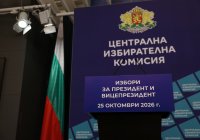 Central Election Commission: With 7.37% of Polling Station Protocols Processed, Iotova and Gyurov Head to a Run-off in Presidential Election on 1 November
 Илияна Йотова: Илюзия е, че ако не се гласува, можем да извършим промяна в страната
 Историческа победа за студентите, Вучич призна загубата си на парламентарните избори в Сърбия









 Чуй новините
 Подкаст