If Tsarevets was the political and spiritual centre of the Second Bulgarian Empire, Trapezitsa was the fortified quarter of the high aristocracy, dotted with numerous boyar residences. And while the former centre has been extensively studied and restored, the boyar quarter still has much to add to our understanding of the Middle Ages. Many legends and tales surround Trapezitsa. One of them tells of a royal mint and a treasure. They may be only legends, but finds uncovered by archaeologists during excavations here are drawing attention in that direction.
Archaeologists are currently investigating two large, representative residences near the southwestern gate of Trapezitsa. They are still working through the uppermost, or latest, layers, dating from the 14th and 15th centuries.
Assoc. Prof. Deyan Rabovyanov, Ph.D., head of the archaeological excavations: "These residences actually date from the 14th century. This was the time of the reigns of Ivan Alexander and Ivan Shishman, and some of them subsequently continued to exist during the Ottoman period until the middle of the 15th century, that is, until the time of Mehmed II the Conqueror. But in the case of this particular building, the researchers have reason to believe that in the 14th century it was by no means residential. The traces are extremely interesting and suggest an important production function.”
Assoc. Prof. Deyan Rabovyanov, Ph.D.: “It is of very substantial dimensions, arranged in a chain right next to the gate and, surprisingly enough, numerous coin blanks were found in and around it – that is, silver coin blanks, pieces of silver ingots and similar items.”
BNT: Does “blanks” mean that it’s something used in in minting coins?
Assoc. Prof. Deyan Rabovyanov, Ph.D.: “It is actually the round disc from which the coin is struck. The blanks appear to be mostly from coins of Ivan Shishman. In other words, their size suggests that they are probably Ivan Shishman coins, which could mean that this was precisely the mint in Tarnovo during the late period, before the fall of Tarnovo – the silver aspers of Ivan Shishman, for example.”
The composition of the silver will quickly show whether Ivan Shishman’s coins were minted here. His aspers had a much lower silver content. Minted on the eve of the Ottoman conquest, they were a desperate attempt to contain the economic crisis. Producing more, smaller coins did not change their denomination. This prompted many people to hide their old silver coins.
Amid the chaos before the Ottoman conquerors arrived, many people buried their money but never managed to retrieve it. This is why most coin hoards date from the time of Shishman – as do many of the legends and tales. But in addition to the silver blanks, archaeologists are uncovering other clues pointing to a mint.
Assoc. Prof. Dr. Deyan Rabovyanov: “There were also remnants of a high-temperature furnace, that is, a furnace specifically used for heating or casting metal. There were pieces of heavily vitrified clay, showing that it really operated at a very high temperature.”
BNT: And this building and the mint were in quite a prominent location?
Assoc. Prof. Deyan Rabovyanov, Ph.D.: “Yes, more or less in a key location, because this is where the two main streets of Trapezitsa intersect. It is no coincidence that this church was built here. It is one of the larger churches, although its construction is not particularly imposing. It was a parish church and served these neighbourhoods.”
It is possible that this building still has more surprises from the time of Shishman in store. For now, however, the archaeologists are pleased with finds from medieval rubbish.
Assoc. Prof. Deyan Rabovyanov, Ph.D.: “At the moment, we are working in situations that are very typical of medieval cities and settlements from the period in general – sunken dwellings with numerous pits. This is, roughly speaking, the rubbish of the Middle Ages. Although they are rubbish pits, they provide a huge amount of material. Above all, ceramic material, from which these beautiful vessels that we usually see in museums can be reconstructed. For example, this sgraffito piece with a four-petalled flower. Beautiful, almost complete sgraffito vessels, or, for example, with this geometric ornament, which is done in this way.”
BNT: Is this the foot of a bowl?
Assoc. Prof. Deyan Rabovyanov, Ph.D.: “Yes, this is the foot of a sgraffito bowl, and a fine sgraffito bowl from the 14th century, since some of these pits cut into layers dating precisely from that period.”
BNT: And does the bowl look like this?
Assoc. Prof. Deyan Rabovyanov, Ph.D.: “This is the bowl, one could say, in almost complete profile. It is a tableware vessel that was relatively widespread and of high quality. Tarnovo was one of the major centres for producing this type of pottery. And, of course, there is also a great deal of kitchen pottery. Although it is kitchenware, it bears this beautiful decoration characteristic of the 14th century.”
BNT: For beans, for example?
Assoc. Prof. Deyan Rabovyanov, Ph.D.: “Well, not specifically for beans—more likely for lentils.”
From the same ancient rubbish pit, the archaeologists have recovered another interesting object – a small conical seal, a surprising find given the context in which it was discovered.
Assoc. Prof. Deyan Rabovyanov, Ph.D.: "They are not common in the Second Bulgarian Empire. Unlike in the First Bulgarian Empire, when they were widespread. These were objects for, let’s call it, personal security. If you wanted to make sure, for example, that your chest had not been opened by a member of the family or someone else, you would seal it with wax using this seal, and if the seal had been broken, it meant that someone had been rummaging through your money box. It has not been cleaned yet. If you look closely from a certain angle, you can see the head and the wing. We assume this is an image of an archangel or angel with an apotropaic, protective function.”
BNT: Does it have a hole?
Assoc. Prof. Deyan Rabovyanov, Ph.D.:“There is a hole because it was worn suspended. They were usually worn on a bracelet around the wrist or around the neck, precisely so that they could be carried continuously.”
The adjacent building is also large, imposing and certainly two-storeyed, like most houses in the cities of the Second Bulgarian Empire. But unlike the first, the finds here suggest that it was primarily used as a residence.
Assoc. Prof. Deyan Rabovyanov, Ph.D.:“This latest building is actually one of the largest we have excavated at Trapezitsa. Over time, three large structures were built one on top of another here, each used at a different time. Starting with around 1250, in the middle of the 13th century. Then came the next building, from the beginning of the 14th century, around 1310–1320, that is, from the time of Tsar Theodore Svetoslav. And finally, the latest building, which dates from after the middle of the 14th century – around 1370, say, from the time of Tsar Ivan Shishman. And again, we have the same situation, with pits that have already been excavated and some isolated graves.”
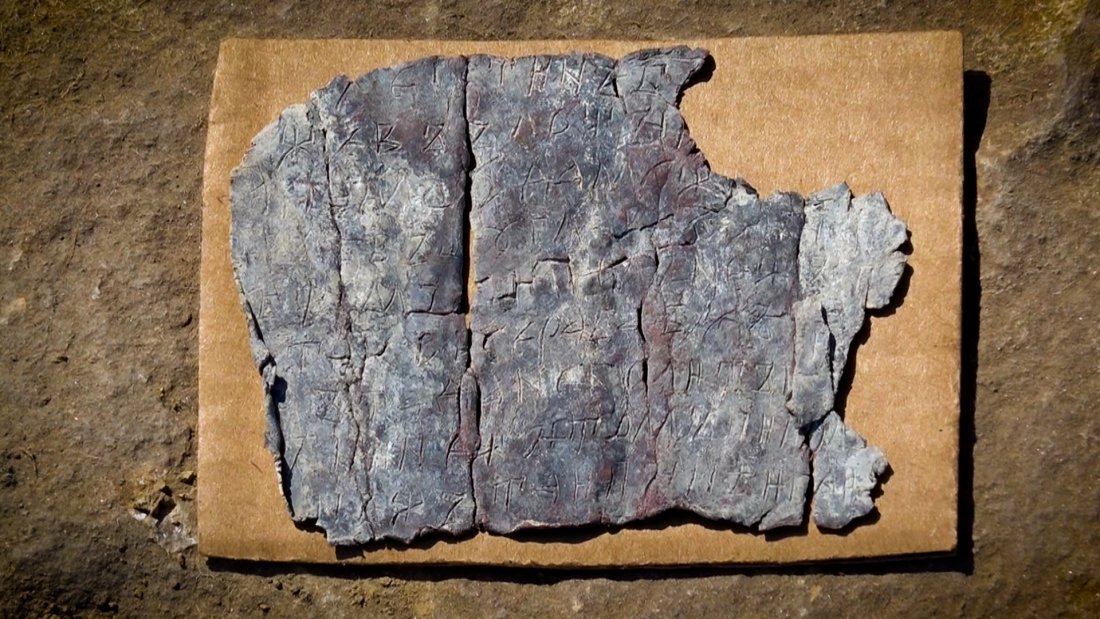
The isolated graves, however, turned out to be much later. Archaeologists have definitively abandoned the idea that the fortress was systematically vacated and abandoned when Tarnovo was captured. The evidence shows that Trapezitsa was briefly inhabited by an Ottoman population until the middle of the 15th century. But life on the hill was difficult, with no source of water, and the fortress had lost its defensive purpose, so the area eventually became deserted. The churches, however, remained visible, and Christians regarded Trapezitsa as a sacred place and continued to bury their dead there. At the feet of one of them, archaeologists found a small lead scroll bearing an inscription.
Assoc. Prof. Deyan Rabovyanov, Ph.D.:“Perhaps the most interesting find of the season. It belongs to a group of objects that are both prayers and amulets for health and protection. These are the so-called prayers against the undead.”
BNT: Is this what you found in this grave?
Assoc. Prof. Deyan Rabovyanov, Ph.D.:“It was actually above the skeleton’s feet. This is a plaque, which you can now see in its unfolded state, after the conservator managed to unfold and clean it. It had been folded up, as I jokingly say, like a banitsa. These amulets were generally carried folded or rolled up, or attached to a string for wearing. This is a Middle Bulgarian inscription, meaning that, according to the linguistic features, the epigrapher’s initial examination indicates that it dates from the 13th–14th centuries, precisely the period of the Second Bulgarian Empire. These prayers against the undead, as they are known here, are more typical of the 10th–11th centuries. They are relatively rare in the 13th–14th centuries, and the discovery of such an inscription – because there is writing on both sides of the plaque – is a relatively rare, I would even say very rare, find for the period. The undead is, so to speak, the evil spirit, or the one who brings disease, the dead who is not at rest. Accordingly, this is a plea specifically for the person to be freed from the undead. The protective prayer ends precisely with ‘Amen, Amen, Amen’ – three Amens – which shows the prayerful nature of the text and the protection it was intended to provide.”
The scroll is not the only intriguing find. A buckle from a hanging belt dating from the 13th–14th centuries reflects Western European fashion that reached these lands with the Fourth Crusade. A silver earring with a cross-shaped pendant and settings for pearls was probably lost. And then there is this remarkably delicate hairpin.
Assoc. Prof. Deyan Rabovyanov, Ph.D.:“They are called hairpins, but in fact these are pins used to secure a veil or a cap. They usually have a much simpler decoration on the visible head. This may be one of the most beautiful we have seen from the Second Bulgarian Empire. It has a filigree bird, a dove.”
A fine example of the jewellery-making skills of the famous goldsmiths of Tarnovo. But alongside the jewellery, archaeologists are also finding numerous arrowheads and even crossbow bolts. All are finds that tell stories of tragedy – and of the end of the Second Bulgarian Empire.







 Чуй новините
 Подкаст