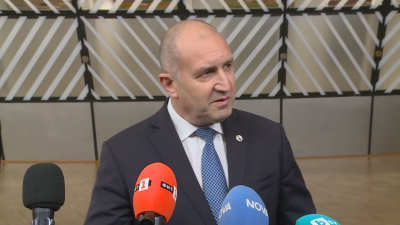
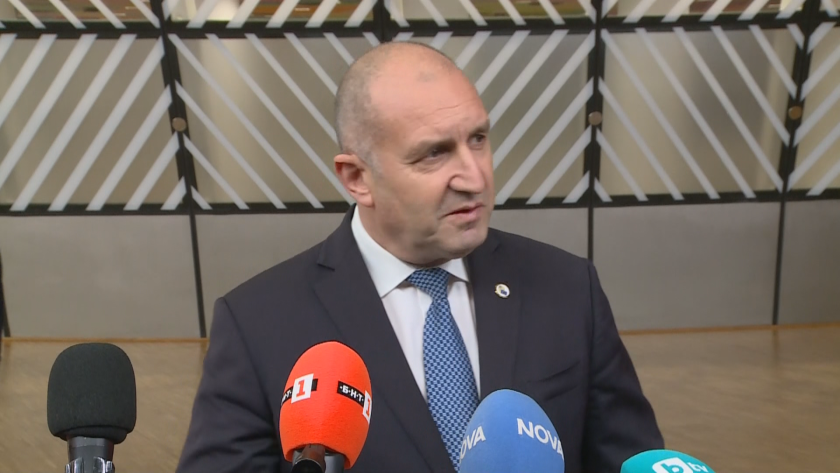
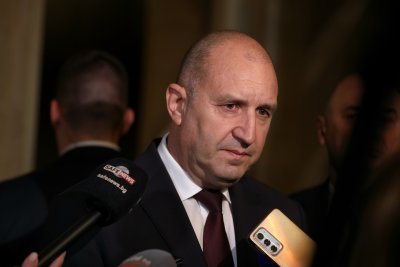
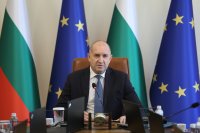
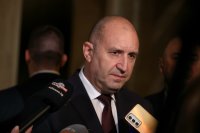
Prime Minister Rumen Radev commented from Brussels on what Bulgaria’s position will be during the discussions on the EU budget.
“There are three key pillars to our demands. First, we must not compromise on cohesion policy. We know that it is the main instrument for ensuring the unity of the Union and promoting its economic development.
Secondly, we insist on clear financial support for the Black Sea region, rather than merely having it mentioned. We all know how heavily countries such as Bulgaria and Romania are involved in activities in the Black Sea, particularly in response to attacks on commercial vessels. These involve substantial costs for us, and they must be taken into account.
Finally, we oppose the introduction of new own resources based on the EU Emissions Trading System and tobacco excise duties. We consider this approach unacceptable because it would disproportionately disadvantage Bulgaria. These are our positions regarding the budget.”
Regarding cohesion, he commented:
“What we are negotiating with President Antonio Costa is beneficial to Bulgaria, at least in terms of our share of the EU budget. And the amount is by no means insignificant, so I very much hope that we can find a good balance that works in our country’s favour.”
The Prime Minister was sceptical that an agreement would be reached today.
“There are quite a few differences that need to be ironed out. However, I am counting on the will and sense of responsibility of all Member States to reach a consensus. Our view is that the budget should be agreed by the end of this year, so that we can start working within this new financial framework from 2028.”
Prime Minister Radev also commented on the European Commission’s recommendation that Bulgaria be fined over its excessive deficit.
“I see this as a matter of purely procedural reasons, because this is the first time the rules on penalties have changed, and it is also the first time this has coincided with the arrival of Bulgaria’s budget.
Do not forget that this was not a standard budget. It was submitted in August. This is the situation we inherited: a change in the political landscape, elections in April, a new government in May and a budget only at the end of July.
So our budget was the first to be subject to the changed rules. Under the previous rules, fines were more than ten times higher. Many countries before us had excessive deficits and were subject to sanctions under the old procedure. However, because the ceiling for fines was so high, no actual fines were ever imposed.
Now the ceiling is very low – as you know, 0.02%. But we are the first country to face an excessive deficit under these new rules.”
Radev stressed that the fine was financially symbolic.
“However, it is certainly significant in terms of reputation, and the opposition in Sofia is making great use of it, even though it is actually responsible for bringing us to this point.”
We would under no circumstances fulfil the opposition’s nihilistic hopes of seeing EU funding and payments under the Recovery and Resilience Plan suspended, Radev said.
“This is absolutely not what is being discussed, and it will categorically not happen. Bulgaria, under our leadership, is pursuing a clearly defined and strict fiscal policy, and this is recognised.
There can be no question of suspending EU funds. This is a standard procedure triggered by an excessive deficit, precisely at the time when our budget was submitted. So there is no uncertainty about that.”
The Prime Minister noted that the European Commission had given a positive assessment of the government’s measures in the 2027 budget.
“In other words, the assessment of our 2027 budget is positive and encouraging. It recognises that, through the measures we are introducing, Bulgaria is beginning to reduce its deficit substantially.
As for whether the situation is unfair – yes, it is unfair, because we have the steepest rate of deficit reduction between 2026 and 2027. I expect some common sense to prevail here, because we should be rewarded for reducing our deficit at such a rate, while there are other countries that have excessive deficits and are not managing to reduce them at all. The procedure against them will be triggered next year.”
Radev also said the European Commission needed to review its ability to assess the financial situation in Member States realistically.
“Why has the European Commission suddenly established that Bulgaria has such an excessive deficit? How has it suddenly discovered that we have macroeconomic imbalances? Excuse me, but these macroeconomic imbalances do not emerge in three or six months. They accumulate over the course of the years.
How has the Commission only now realised that public funds in Bulgaria are being spent indiscriminately, without the necessary ovrsight?
How was Bulgaria suddenly able to bring down inflation in April and May last year, just enough to meet the criteria for the convergence report, only for inflation to exceed all the criteria again in August?
There are issues here that the European Commission needs to examine, particularly its ability to assess the financial situation in Member States realistically. If it fails to do so, it means that our accession to the eurozone was driven by political rather than economic considerations.”
Radev also commented on the possibility of Chinese investment in Bulgaria.
BNT: “Do you expect Chinese investment to compensate for what we might lose from the next EU budget?”
Radev: “Let us first get to the stage of securing investment. But I very much hope this issue will not be unnecessarily politicised and that we will avoid the apocalyptic scenarios being painted around these investments.
President Macron, Prime Minister Sánchez, Mitsotakis and other European leaders are all travelling along this same path. Ask them why Macron has visited China four times, why Sánchez has visited China four times, not to mention Merz and Mitsotakis, among others.
Chinese investment in Europe has so far reached around €40 billion in Germany, €25 billion in France, €12 billion in Spain and €5 billion in Hungary and Greece. Surely we need to catch up with these countries? That is precisely what we are doing. We will catch up, and we will work to secure Chinese investment in Bulgaria.
But what are our options? There are two. China will invest in electric vehicle factories in Europe in any case. That is going to happen regardless. We have two paths ahead of us.
One is to once again let these investments pass us by, with factories being built in another European country and us having to buy the vehicles from there.
The other is to secure that investment for Bulgaria, so that we can manufacture these vehicles ourselves, retain the added value here and sell them to other countries, thereby generating greater returns.”
Bulgaria wants to introduce a new approach to the loan for Ukraine and is prepared to contribute to the budget for non-military support.
“I want to make a very clear distinction between Bulgaria and the Czech Republic, Slovakia and Hungary. The Czech Republic, Slovakia and Hungary refused from the very beginning to participate as guarantor countries for this loan. From the outset, both in 2025 and in 2026, they said no and did not take part.
By contrast, the government of Rosen Zhelyazkov, a position subsequently reaffirmed by the government of Andrey Gyurov, has so far agreed to act as a guarantor for two loans: €45 billion last year and €45 billion this year. In other words, Bulgaria has already committed to guaranteeing loans worth €90 billion, and we are paying the interest on these loans through the common EU budget.
The question now concerns next year and the request for a further €45 billion loan.
At our explicit insistence, and I am pleased that the European institutions and Antonio Costa are now accepting this position, we will discuss the matter today with Ms von der Leyen as well. She has already expressed support for our proposal to divide the loan into two components: €25 billion for military assistance and €20 billion for non-military budgetary support.
We are prepared to contribute to the non-military assistance, provided that we make it clear that our contribution as guarantors must be specifically directed towards areas with compact populations of ethnic Bulgarians belonging to our historical community.
There are more than 300,000 Bulgarians in Ukraine. They need healthcare, heating, electricity and transport. I therefore hope that the European Commission will accept this approach, which we will continue to insist on, because, on the other hand, we cannot shirk our responsibilities as a state and as a society towards our historical diaspora and our compatriots in Ukraine.”
No official information about the Lukoil deal has been received by the Bulgarian government, the Prime Minister said.
“If you remember, at the previous European Council meeting I raised this issue here in front of you and also during the meeting itself.
Lukoil is a strategic asset not only for Bulgaria but for the whole of Europe, particularly at a time when Europe has closed many of its refineries over recent decades and is now facing a shortage of diesel, not to mention aviation fuel.
I raised the question both with the Commission and elsewhere, and I am still waiting for an answer. Will the European Commission and the Council take an active role to ensure that Europe has a say and plays a part in the Lukoil deal? Because at present, it does not.
The future of Lukoil is being decided outside Bulgaria and outside the European Union. And that is a challenge for us.
So I cannot tell you anything more about this deal, because the Bulgarian government has still received no official information about what is happening between OFAC and the US side, or about a potential buyer on the other side.”
Radev also commented on the European Commission’s call for Russian athletes to be banned from competing in sporting events in Europe as part of the 22nd package of sanctions against Moscow.
“This is not just about athletes. We are also talking about tourism linked to sporting events and activities, and even cultural events.
I think we are going too far by politicising sporting and cultural events in this way. We therefore have reservations about this proposal.”







 Чуй новините
 Подкаст