Bulgaria’s population is 6,423,207 as at 31 December 2025, according to data released by the National Statistical Institute.
Compared with 2024, Bulgaria’s population has decreased by 14,153 people, or 0.22%, according to the National Statistical Institute.
Men number 3,088,245, accounting for 48.1% of the population, while women total 3,334,962, or 51.9% — meaning there are 1,080 women for every 1,000 men.
The number of men exceeds that of women up to and including the age of 55. As age increases, both the number and relative share of women in the total population rise.
At the end of 2025, people aged 65 and over numbered 1,557,851, or 24.3% of the country’s population.
Regionally, the highest share of residents aged 65 and over was recorded in Vidin Province (31.6%), Smolyan Province (31.1%) and Gabrovo Province (30.8%).
The lowest proportion of elderly residents was in Sofia (19.2%) and Varna (21.7%).
As at 31 December 2025, children under the age of 15 in Bulgaria numbered 891,674, accounting for 13.9% of the total population.
The highest proportion of people under 15 was recorded in Sliven district, where they made up 18.7% of the regional population, followed by Yambol district at 15.2%.
The lowest share was in Smolyan district at 10.0% and Vidin at 11.4%.
The overall age dependency ratio stood at 61.6%.
It was lowest in Sofia at 50.9% and highest in Vidin district at 75.4%.
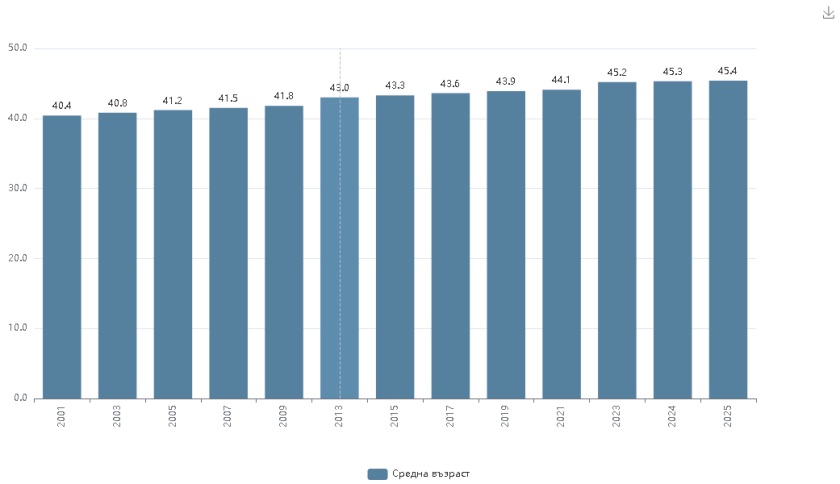
The ageing population has continued to push up the average age, which reached 45.4 years by the end of 2025.
The average age of the urban population was 44.6 years, while in rural areas it was 47.7 years.
Over the years, both the number and the relative share of the population below, within and above working age have changed.
The composition of the population within and above working age is influenced both by the ageing of the population and by legislative changes affecting retirement age thresholds.
For 2025, the upper age limits for the working-age population are set at 62 years and 4 months for women, and 64 years and 8 months for men.
As at 31 December 2025, the working-age population in Bulgaria stood at 3,764,842 people, accounting for 58.6% of the country’s total population.
Of these, 1,967,204 were men and 1,797,638 were women.
By the end of 2025, 1,700,684 people, or 26.5% of the population, were above working age, while 957,681 people, or 14.9%, were below working age.
The reproduction of the working-age population is measured by the demographic replacement ratio, which shows the relationship between the number of people entering working age (15–19 years) and those leaving working age (60–64 years).
As at 31 December 2025, the demographic replacement ratio stood at 75 people.
The most favourable values of the demographic replacement ratio were recorded in Sofia at 99, Sliven district at 96, and Varna at 89.
The lowest values were registered in Kardzhali district at 46, Smolyan district at 49, and Silistra district, where every 100 people leaving working age are replaced by just 55 people entering the workforce.
As at 31 December 2025, 4,745,686 people, or 73.9% of Bulgaria’s population, lived in urban areas, while 1,677,521 people, or 26.1%, lived in rural areas.
At the end of 2025, there were 5,256 settlements in Bulgaria, of which 257 were towns and cities and 4,999 were villages.
A total of 192 settlements were uninhabited.
In 1,280 settlements, or 24.4% of all populated places, the population ranged between one and 49 residents.
The largest village was Lozen, located within the territory of the Sofia Municipality, with a population of 6,671.
The smallest town was Melnik, with a population of just 181.
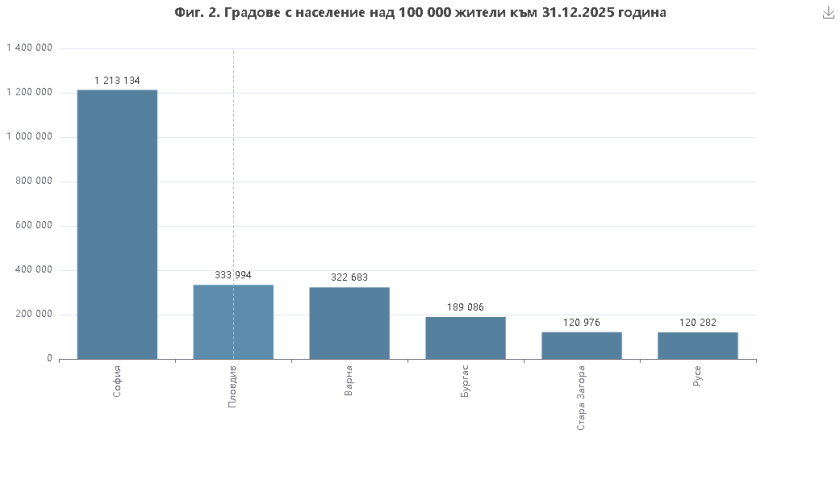
Six cities had populations of more than 100,000 people, and together they accounted for 35.8% of the country’s population.
More than half of Bulgaria’s population (51.9%) lives in the South-West and South-Central statistical regions.
The least populous region is the North-West, with 647,000 residents, or 10.1% of the country’s population.
In 2025, only one statistical region recorded population growth compared with 2024 — the South-West region, where the population increased by 0.15%.
Population declined in all other statistical regions.
Compared with 2024, five provinces recorded population growth, with the largest increase seen in Kardzhali Province at 1.7%.
The largest population decline was reported in Smolyan Province, where the population fell by 1.9%.







 Чуй новините
 Подкаст