“Democratic Bulgaria” have submitted a signal to the General Directorate for Combating Organised Crime (GDBOP), containing data that raises reasonable suspicion of possible informal influence in the awarding and execution of public procurement contracts.
The trigger for the complaint is said to be frequent trips by MRF Leader, Delian Peevski, to Dubai. The party is calling for an investigation into whether, around these visits, there was any informal coordination with representatives of companies involved in public procurement procedures.
The formation emphasises that travelling abroad in itself does not constitute wrongdoing. However, it argues that several circumstances warrant scrutiny — including the frequency of the trips, the destination, and the possibility that individuals linked to companies participating in public procurement may have been in Dubai at the same time.
The signal requests that GDBOP establish all of Peevski’s trips to Dubai over the relevant period, including dates of departure and return, routes, transport providers, specific flights, any accompanying persons, and the type of transport used — scheduled flights, charter services or private aircraft.
Following that, GDBOP is expected to request and analyse data from the General Directorate “Border Police” regarding individuals who travelled to Dubai or the United Arab Emirates up to two days before each of Delyan Peevski’s respective trips, as well as those who returned up to two days after his return.
This time window, according to the request, would make it possible to identify whether there were people travelling in a coordinated manner, even if they were not on the same flight or did not travel on the same day.
The coalition also states that, in order to establish the full facts, the list of travellers should be cross-checked with the Commercial Register and the Register of Legal Entities with Non-Profit Purpose. The aim is to determine whether any of them are owners, managers, authorised representatives or otherwise connected to companies participating in public procurement procedures.
“Democratic Bulgaria” also points out that the focus is not only on publicly visible ultimate beneficial owners. What is also important, they argue, are individuals who play a factual or formal role within corporate structures but are not always immediately identifiable.
Another key question is whether related companies have participated in public procurement procedures, whether they have won contracts, received annexes, indexation adjustments, advance payments or other forms of financial benefit from public funds.
The timing element is considered particularly important. If, after a trip to Dubai, a procurement procedure is announced, conditions are changed, competitors are disqualified, a contract is signed, or an advance payment is made in favour of a related company, this would constitute a serious indicator warranting investigation.
For this reason, the signal also extends to contracting authorities. It suggests that it should be established who initiated the procedures, who defined the technical specifications, deadlines, and estimated value.
The formation also insists that signs of pre-arranged public procurement outcomes should be examined.
As examples, they cite restrictive conditions, unusually short deadlines, requirements tailored to the profile of a specific company, lack of genuine competition, participation by related companies, subsequent amendments to contracts, large advance payments, or unjustifiably inflated contract values.
The financial trail is described as equally important. The signal requests checks for possible financial flows between identified companies, their owners, managers, related persons, consultants, intermediaries, and individuals within the political or administrative circle of Delian Peevski.
The aim, they say, is to clarify whether a mechanism of influence, remuneration, concealment of benefits or subsequent distribution of funds may exist. If such a mechanism were established, it could indicate coordinated actions between politically influential individuals, representatives of commercial companies, and officials from public contracting authorities.
Depending on the findings, it may be possible to establish evidence of trading in influence, abuse of office, corruption offences, or irregularities in the awarding of public procurement contracts.
“Democratic Bulgaria” is urging GDBOP to carry out a full investigation and, upon its completion, to provide information—within the limits permitted by law—on the actions taken and the results obtained.


 Iliana Iotova after Her Meeting with Robert Fico: 'Ukraine Conflict Has No Military Solution'
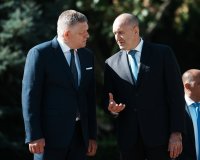 Prime Ministers Radev and Fico Comment on Nuclear Energy as Key Factor in Achieving Climate Neutrality
 Велислава Петрова се срещна с майката на Ива Михайлова и я увери в подкрепата на правителството
 Господинов с наградата „Жан Моне“: "Литературата е антидот срещу разпада"
 Коледен бонус за най-бедните: Около 500 000 души ще получат по 50 евро










 Чуй новините
 Подкаст