A new parliamentary configuration and redistribution of votes is emerging ahead of the elections scheduled for 19 April 2026, according to a nationally representative survey by Gallup International Balkan.
The poll, conducted between 10 and 28 February 2026, indicates that around 51% of voters have already formed their electoral preferences, outlining the current snapshot of pre-election attitudes among the public.
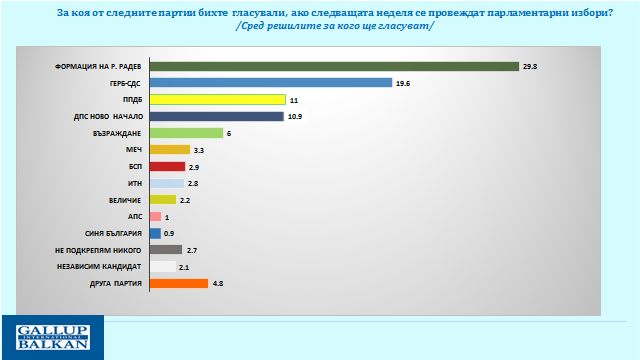
Among voters who have already decided whom to support, the political formation associated with Rumen Radev is receiving strong initial backing of 29.8%, though this remains insufficient for an outright parliamentary majority.
According to the survey by Gallup International Balkan, the structure of this support shows that it largely comes from voters shifting from other parties, rather than from citizens who previously abstained from voting.
The data indicate that the largest influx of support comes from voters of the following political forces:
62.5% of those who voted for BSP – United Left in October 2024 say they would now support Radev’s formation.
46.7% of voters of Vazrazhdane would also switch their vote.
30% of voters of MECh (Morality, Unity, Honour) would do the same.
20.7% of those who supported We Continue the Change – Democratic Bulgaria (WCC–DB) indicate they would now vote for the new formation.
Researchers note that support for the Radev-backed formation could remain highly volatile during the campaign, potentially rising or falling depending on factors such as the strength of the campaign, the candidates presented, political messaging, and the ability to mobilise voters who did not participate in previous elections.
In second place is the coalition GERB–UDF, which attracts the support of 19.6% of voters who have already decided whom to back. The formation led by Boyko Borisov appears to maintain the stability of its core electorate. Analysts say any narrowing of the gap with the leading formation will depend largely on the effectiveness of its election campaign.
The coalition We Continue the Change – Democratic Bulgaria (WCC–DB) currently ranks third with 11.0%, but shows a downward trend. The decline is linked to the public controversy surrounding the “Petrohan” case and the coalition’s association with the caretaker government, issues that dominated public debate during the period of the survey.
Analysts note, however, that a mobilisation of protest voters could still improve the coalition’s current result as the campaign unfolds.
Following WCC–DB, the MRF – New Beginning receives 10.9% of decided voters. Traditionally, the movement demonstrates strong capacity to mobilise its electorate ahead of elections, providing potential for further gains.
In the current political landscape, the party Vazrazhdane attracts 6.0% support. Despite a notable decline, it remains comfortably above the 4% electoral threshold required to enter Parliament.
Below them, with varying likelihoods of parliamentary entry, are:
MECh – 3.3%
BSP – United Left – 2.9%
There Is Such a People – 2.8%
Velichie – 2.2%
With 1% of decided voters, Alliance for Rights and Freedoms would remain outside the future National Assembly if elections were held today.







 Чуй новините
 Подкаст