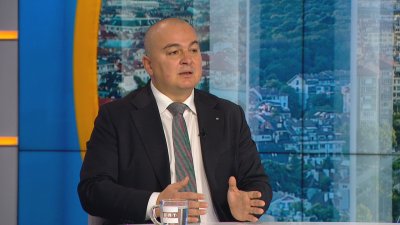
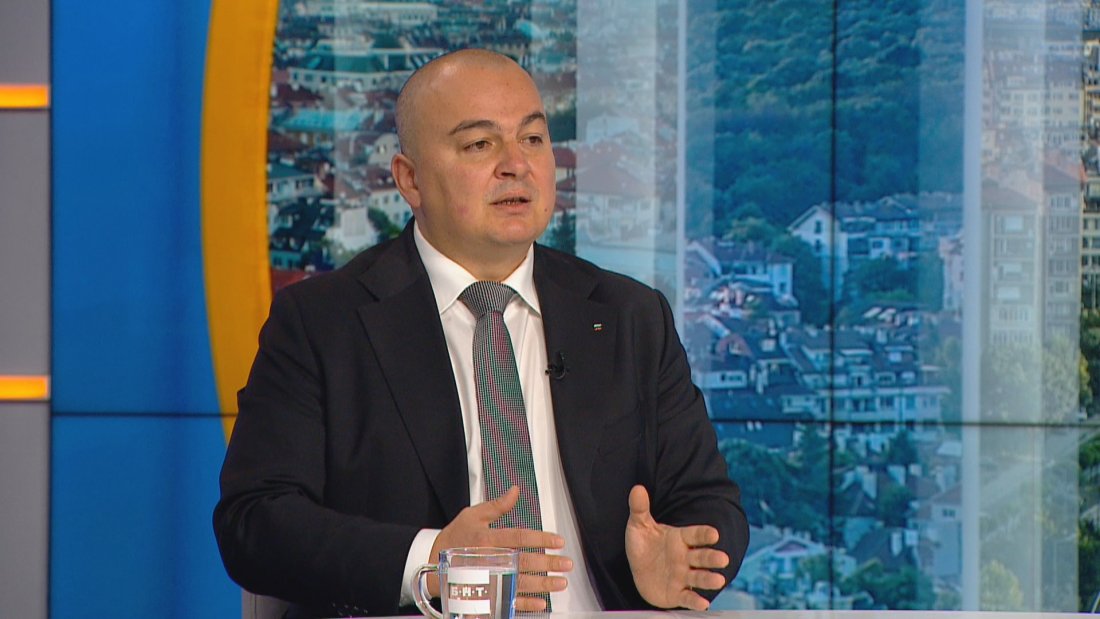
A bill regulating large retail chains will be submitted to parliament by the end of the year, as Bulgaria is the only country without such legislation. This was announced by Minister of Agriculture and Food Plamen Abrovski during an interview on the programme The Day Begins on November 5.
Plamen Abrovski, Minister of Agriculture and Food: “We are also the only country without legislation regulating retail chains themselves, including their opening hours and whether they are allowed to open stores, as well as how large those stores can be. Because, let’s be honest: when you have two stores belonging to the same chain concentrated within 500 metres of each other in Sofia, and another two spring up around them, what happens to traffic congestion? What happens to noise levels? When I spoke to a representative of one of these retail chains, he told me: ‘Look, we are going to invest €150 million in Bulgaria.’ And I said: ‘That’s excellent. You will invest €150 million and build new stores, but will you recoup that investment by charging higher mark-ups to Bulgarian consumers?’”
- How did they respond?
“Well, he said he had not given the matter any thought.”
State institutions are carrying out inspections of every store belonging to one of the four major retail chains, with checks taking place yesterday, today and tomorrow, the agriculture minister added.
Plamen Abrovski, Minister of Agriculture and Food: “We’re not going after anyone. We’re conducting inspections and want to ensure that Bulgarian citizens eat high-quality, healthy, and safe food, and we want to understand how pricing works—why milk is cheaper in Luxembourg than in Sofia.”
According to Abrovski, the state has launched comprehensive inspections throughout the supply chain, working both from the bottom up and from the top down, to establish the origin of products when inspectors enter a commercial warehouse.
Plamen Abrovski, Minister of Agriculture and Food: “We want to establish whether there are products grown in Greece but labelled as Bulgarian, thereby distorting our support schemes and putting Bulgarian agricultural producers at a disadvantage. We also want to determine whether there are uncontrolled mark-ups further down the chain, at the trader-to-trader level.”
Bulgaria's Exclusive Economic Zone, which forms part of its maritime waters, is entirely safe. Ships carrying Bulgarian grain can pass through the area without any difficulty, and there have been no disruptions to deliveries, Minister Abrovski stressed.
In his view, the problems affecting Bulgarian grain exports, which have been reported by industry representatives, are caused by high fuel prices and the increased cost of transporting grain from Vidin to Varna.
Plamen Abrovski, Minister of Agriculture and Food: “The price of grain in the Varna region is higher because transport costs are added to it, whereas in Vidin the price is lower by the amount of those transport costs. And when you also have a shortage of fuel and lorry drivers are unwilling to make the journey, exports become difficult. We are talking about five million tonnes. This is an industry. But let’s do a simple calculation. If you divide five million tonnes into lorry loads of 22 tonnes each, how many lorries are we talking about? We are talking about tens of thousands of lorries which, in the absence of a motorway, you can imagine how much they obstruct traffic.”
To facilitate exports, all railway stations equipped with weighbridges are also being inspected. The aim is to restore the system that was in place before 1989 and ensure that Bulgarian grain can be transported by rail to Varna. This would spare Bulgarian citizens the additional lorry traffic while the motorway is being built, help facilitate transport, reduce transport costs and give grain producers some breathing space, the minister added.
– Will there be any compensation mechanism to offset high fuel prices, so that producers can transport their goods at this stage?
Plamen Abrovski, Minister of Agriculture and Food: “Compensation for high fuel prices can be provided, but it is intended for the production process itself. The Bulgarian state has allocated €170 million in state aid. Of this, €100 million will cover the difference in fuel prices between 2025 and 2026. But here we are talking about production in the fields, not transport. That is the responsibility of traders. That is why I say that we are providing €100 million in compensation, along with a further €80 million to cover the difference in the cost of trips.”
The agriculture minister also explained the changes to the way agricultural producers receive financial support, which have already prompted discontent and warnings of protests across the sector.
Plamen Abrovski, Minister of Agriculture and Food: “From the moment we took office, one of our challenges was to ensure that we saved all the available European funds rather than lose them. We were at risk of having to return €62 million to Brussels. In my view, returning €62 million to Brussels would be a failure of our duty as a state. That is why my team and I decided to activate a measure that had never previously been implemented in Bulgaria. The measure works as follows: if you experienced a catastrophic event in 2025 – in this case, we used drought as the example – you can demonstrate that you suffered a 30% loss in production, and support can then be provided to those who have incurred losses of at least 30%. In other words, for the first time, we are directing assistance to where it is actually needed.”
- How is production calculated?
- “It is very straightforward. The year 2025 is taken as the reference year, and the agricultural producers’ output is assessed against the period from 2020 to 2024. The highest and lowest production figures are excluded, and the remaining three years are averaged arithmetically. This average is then compared with the figures for 2025.”
The problem, Abrovski added, is that until now funding in Bulgaria has always been distributed indiscriminately, on a per-person, per-animal or per-hectare basis. Agricultural producers have become accustomed to the idea that, regardless of whether support is needed everywhere or only in specific areas, everyone should receive an equal share.
Plamen Abrovski, Minister of Agriculture and Food: “In this particular case, that is not possible because the European Commission itself is changing the way support is provided. This is important for us, too, because more than €1.7 billion is spent through the Ministry of Agriculture every year. By 31 December this year, we will have paid €1.7 billion to agricultural producers. That is almost one-third of the Health Insurance Fund’s budget, do you understand? And when, from 2007 to 2025, you have been handing out money simply for the sake of distributing it, you distort production. This money should be used to shape and structure production.”
The calculations are based on data submitted by the producers themselves, Abrovski added. He also explained that, to address concerns that the money would once again fail to reach those who need it, the state had announced that producers who do not qualify for support under the scheme would receive funding through the de minimis aid programme.
Plamen Abrovski, Minister of Agriculture and Food: “We need to strike a balance because, let’s be honest, you cannot spend 19 years giving everyone an equal amount without taking account of whether there is a need for support, and then suddenly create chaos in the system by starting to target assistance specifically where it is needed.”
From this point onwards, and throughout next year, the Ministry of Agriculture's main priority will be water resources and irrigation. The ministry will also digitalise irrigation canals and pipelines, Abrovski added.







 Чуй новините
 Подкаст