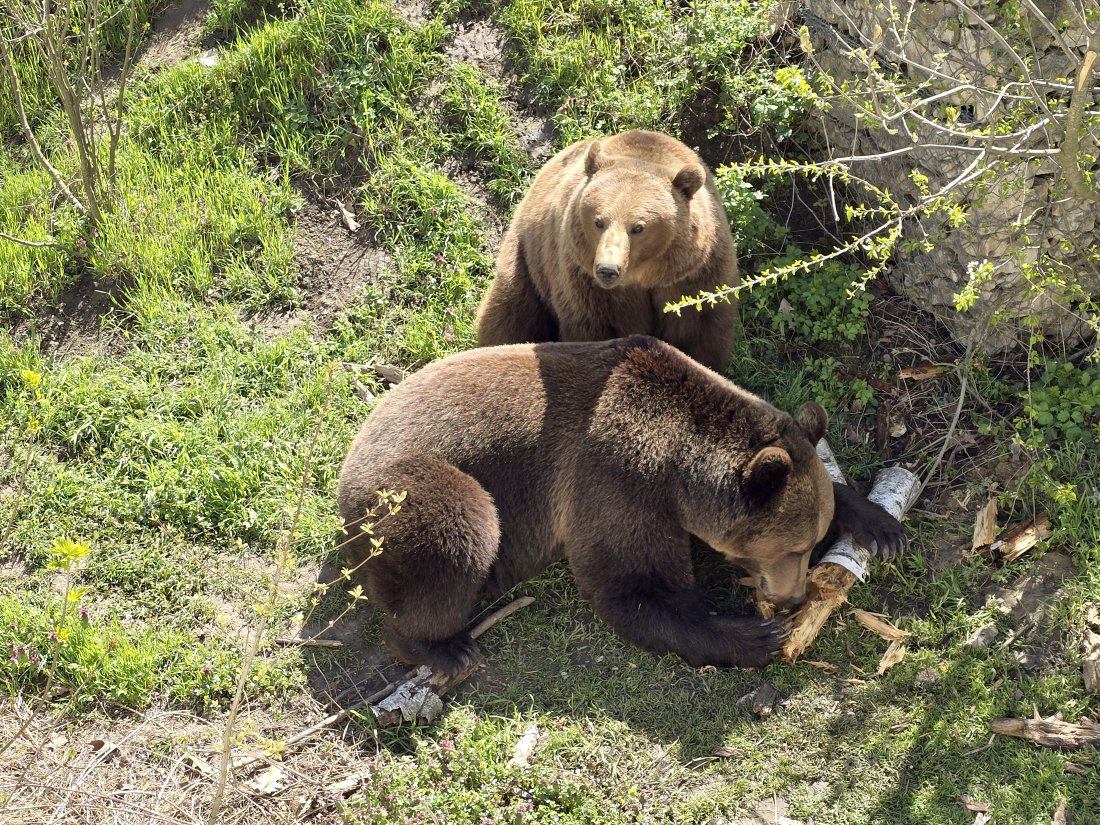


The municipality of Borino in the Rhodope mountains plans to establish a community for peaceful coexistence with bears, WWF Bulgaria said.
That would make Borino the first municipality in Bulgaria with a plan for peaceful coexistence with bears, using the bear-smart communities model developed in Canada in the 1990s. The steps towards establishing the community were discussed at a meeting involving a WWF Bulgaria representative, Borino Municipality, the local community, the Regional Inspectorate of Environment and Water – Smolyan, and forestry authorities. The meeting was organised by WWF Bulgaria as part of the “Together for Nature” project, with the support of the Swiss-Bulgarian Cooperation Programme, the organisation said.
The idea is to develop a pilot, comprehensive concept in Borino Municipality for preventing all types of conflict situations involving wild animals, and bears in particular, Alexander Dutsov of WWF Bulgaria told the Bulgarian News Agency (BTA). According to him, successful examples of bear-smart communities can be found in Canada, Italy, Romania and Greece. These communities are based on a comprehensive approach that is coordinated with the local population, the municipality, and farmers, taking into account the interests of all groups.
Borino Municipality was selected for the pilot project because of problems with bear incursions in the area. As a first step, surveillance cameras are planned for locations identified by local residents as conflict hotspots. The measures discussed also include installing electric fencing, planting fruit-bearing forest trees and fitting rubbish bins with bear-proof protection mechanisms.
Bear attacks in the Borino area and Smolyan Province have not been particularly numerous this summer, according to data from the Regional Inspectorate of Environment and Water – Smolyan and information provided by Alexander Dutsov. More problems with the protected species have been observed in the mountainous region in previous years, when climate anomalies resulted in scarce food supplies from fruit-bearing forest trees. Climate change and global warming are also factors exacerbating human-bear conflict, Dutsov explained.
“In recent years, there have been extreme temperatures and rainfall, as well as very warm winters, which affect the availability of fresh water for drinking and agriculture, and the flowering and fruiting of many trees and shrubs,” Alexander Dutsov added. According to his forecasts, significant migration waves of wild animals could be expected in the future towards areas with more fresh water or greater biodiversity of trees and shrubs.
Bear-related problems in the mountainous region are also linked to the depopulation of villages, the overgrowth of former grazing land and the emergence of new forest that is encroaching on people’s old homes. This is bringing nature closer to populated areas and is a contributing factor to a considerable number of fires, according to Alexander Dutsov.
Source: BTA
Water Crisis at Srebarna Nature Reserve: What Measures Are Being Taken? (PHOTOS)
Powered Hang Glider That Crashed Into Sea Near Ravda Was Unregistered and Poorly Maintained
Съдът в Пловдив пусна от ареста младежите, обвинени за побоя над двама непалци
След убийството в Пловдив: Държавата засилва превенцията срещу детската престъпност
Инфлуенсърът Стоян Колев отива на съд за агресивно шофиране, пневматична пушка и употреба на кокаин