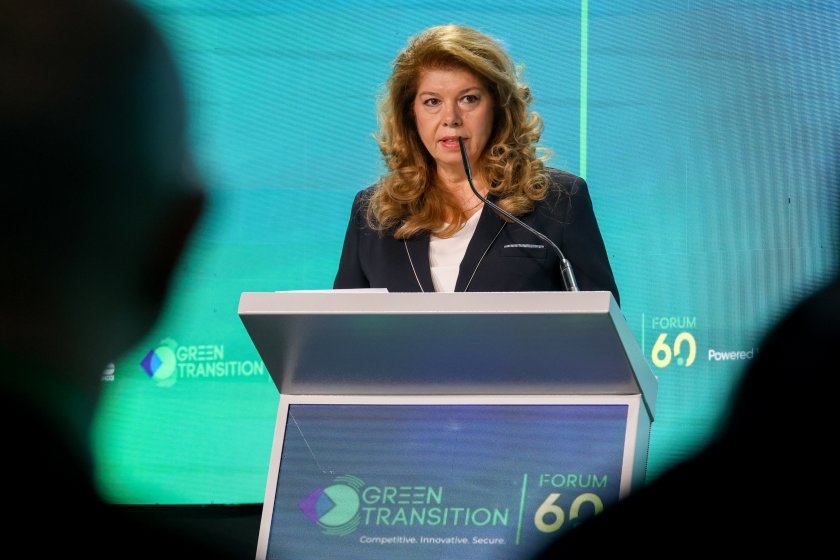
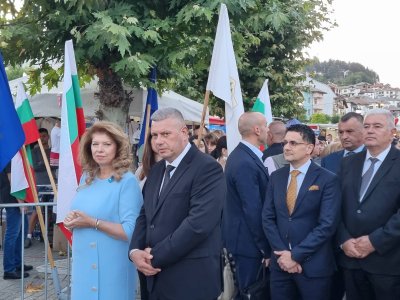
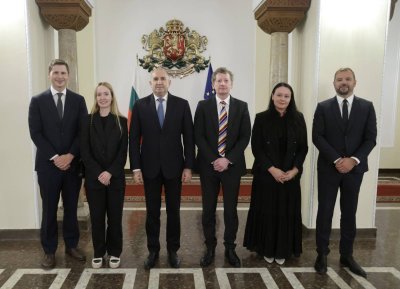
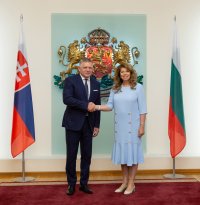
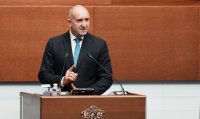
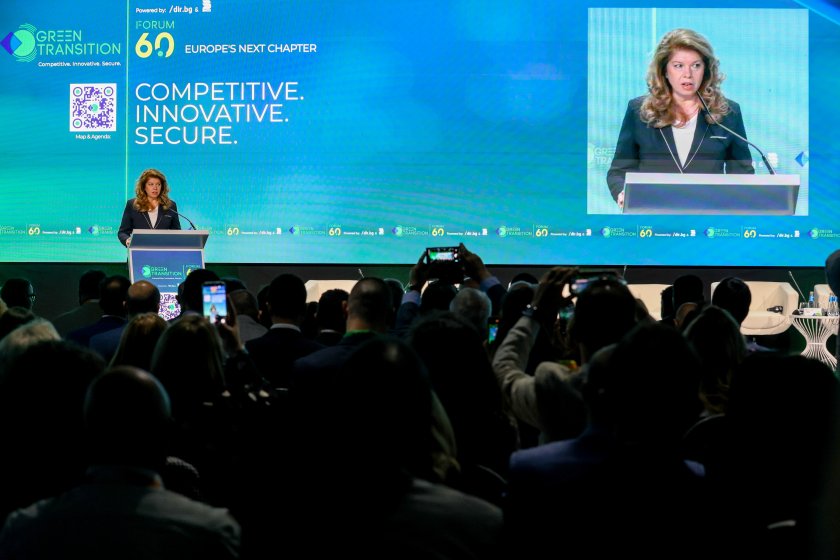
Bulgaria's President Iliana Iotova opened the sixth edition of the Green Transition Forum, organised by Dir.bg. The forum focuses on the future of Europe – competitiveness, energy, innovation and the green transition.
Iliana Iotova, President of the Republic of Bulgaria: “This year’s message carries a particularly significant responsibility – the next chapter for Europe: competitive, innovative and secure. These three words – competitiveness, innovation and security – define the major question facing the European Union today. Europe must embrace new ambitions and even greater determination. The world has changed rapidly. Wars and conflicts have brought the issue of security back to the centre of the European agenda. Global supply chains have been reshaped. In this environment, competitiveness is not a technocratic term. It is now a matter of security, incomes, workforce, social stability and political dignity. Sofia is the right place for this conversation.”
The forum is a cause dedicated to a more developed Europe. Bulgaria understands what it means to be a frontier, to connect regions, the Head of State emphasised.
“Europe cannot be competitive if parts of its regions remain on the periphery. My message is clear. European competitiveness will be strengthened through genuine cohesion, a single market without hidden barriers, access to capital, artificial intelligence, and the participation of all Member States in the new phase of economic development. We need a review and a precise assessment of our policies to date. Cohesion policy must continue. We must conduct a thorough evaluation of the Recovery and Resilience Facility, which was intended to be the major accelerator in the post-pandemic period, yet delays and shortcomings emerged regarding who used the funds and how they were utilised. What has been the outcome of the Green Deal?”.
“Today, the SAFE instrument places a particular emphasis on defence,” Iotova noted.
“Europe should be capable of defending itself, but loans alone cannot build the European defence industry if there is no genuine market for joint production. Competitiveness begins with the ability to deliver – to ensure that projects are completed and implemented.”
The President also commented on the European Union’s Multiannual Financial Framework.
“The debate surrounding it is far more than an accounting dispute. It is a debate about the very nature of the European Union – whether it will remain a union of solidarity and convergence, or become a union of different speeds. The European Commission’s proposal for a new budget of nearly €2 trillion introduces the right concepts: flexibility, security and innovation. However, when agriculture, cohesion policy, social policies, reforms and investments are brought together under a single mechanism, transparency may be diminished.
I want to underline one point in particular: the most vulnerable regions could lose their guaranteed visibility and once again be treated as second-tier priorities. We are concerned that cohesion policy and agriculture may be placed in competition with one another. Until now, they have developed side by side. Bulgaria must state clearly that Europe’s new priorities – defence, innovation, artificial intelligence and energy security – are necessary, but they must not be pursued at the expense of cohesion policy.”
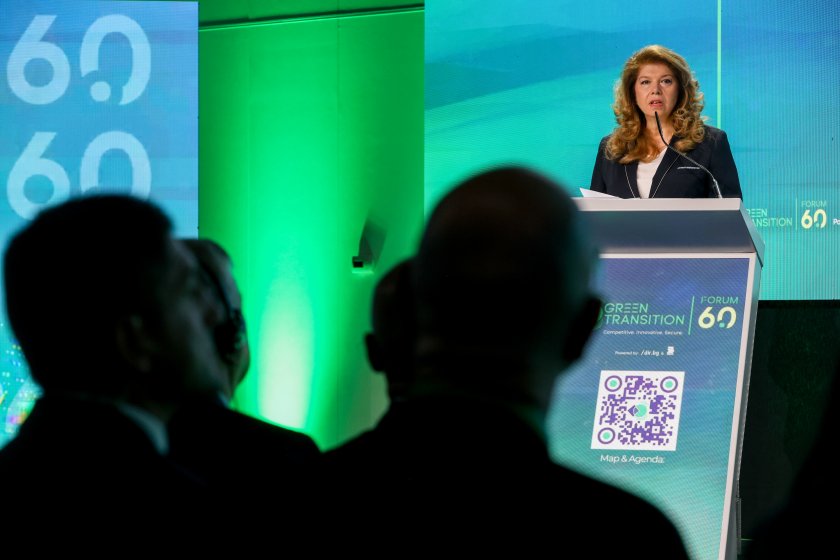
European funding should not be linked solely to reforms on paper. It is the backbone of our economy, Iotova said.
“There was one group of countries that wanted industrial production to return to the European Union. There was also another group that argued that this was something we could not afford. We must encourage European manufacturing.
“I propose that the European Union adopt its first map of energy and transport deficiencies, complete cross-border corridors, establish a framework for artificial intelligence and data, create a European market for defence procurement, and introduce dedicated instruments for regions that are lagging behind.”
A two-speed Europe is the wrong answer to an existing problem, Iotova said.
“Some countries want to move ahead more quickly. It may appear to offer an opportunity for faster decision-making, but it also risks creating invisible borders within the Union. The European Union was not created to divide countries into first and second-class members.
“If one group of countries is always making the decisions while another is left trying to catch up, the consequences will be serious. Projects must remain open and the rules must apply equally to all. Otherwise, we will end up with a Europe of regional blocs. A united Europe is more necessary than ever.
“Bulgaria can and should be an active participant in the new era of competitiveness. Bulgaria can become an energy hub. The Vertical Gas Corridor demonstrates the country's strategic importance for European energy security.”
“Bulgaria must insist that this corridor becomes not only a gas corridor, but a broader energy corridor. Interest in the project continues to grow.
“Bulgaria can be a transport and logistics hub. Bulgaria can be a digital and artificial intelligence hub. Bulgaria can be an industrial partner.
“From Sofia, we will put forward proposals that the financial framework for the 2028–2034 period should preserve cohesion policy and avoid setting farmers against mayors. There must be regional guarantees.
“The European Union must adopt an accelerated plan for energy interconnectivity.”
According to the President, the Greece–Bulgaria–Romania–Moldova–Ukraine axis should be recognised as strategically important for both trade and defence.
“Europe will not become more competitive if it remains fragmented. It will not become more secure if it serves as a market for only a handful of countries.
“A competitive Europe is a Europe that follows through on what it has started and delivers on its commitments.
“Our primary objective – at least my objective – is for Europe to regain its position as a global leader.”





 Чуй новините
 Подкаст