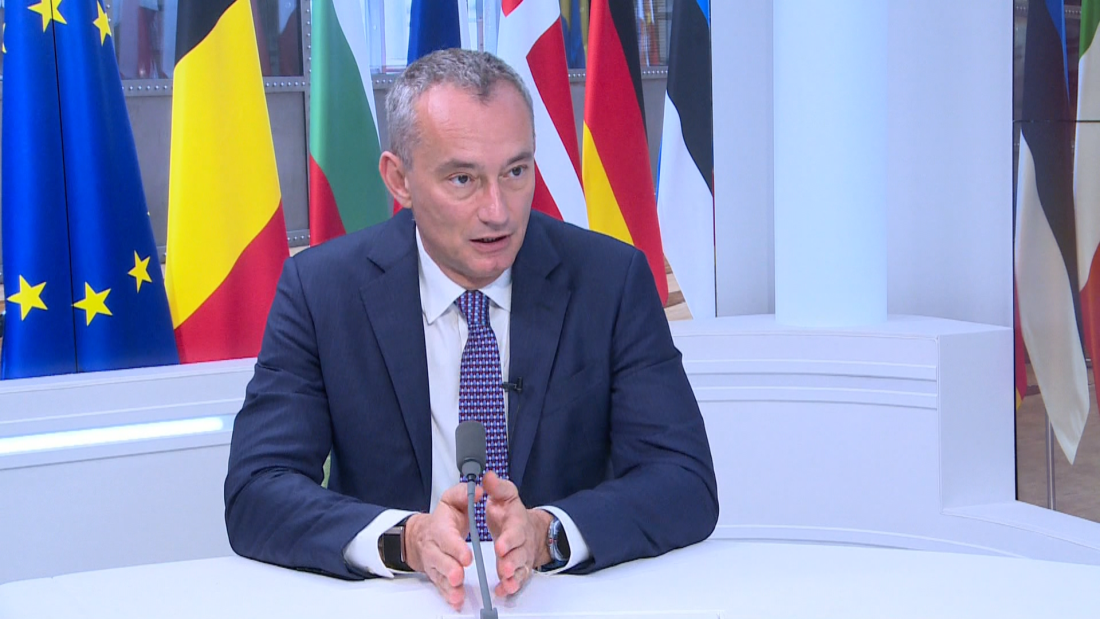
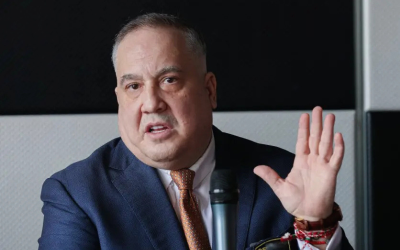
Nickolay Mladenov, the High Representative for Gaza, has given his first interview to a Bulgarian media since assuming the role. On the challenges facing the Middle East and how to implement the Gaza plan, he spoke to Desislava Apostolova in Brussels on February 24.
– Mr Mladenov, it is no secret that among European Union member states, and even within European institutions, there is considerable disagreement over support for Donald Trump’s Board of Peace. At the same time, Europe wishes to participate in the reconstruction of Gaza. Europe is the largest donor to the Palestinians. What exactly did you tell the EU foreign ministers, and what precisely do you expect from the European Union?
Nickolay Mladenov, High Representative of the Board of Peace for Gaza: Thank you. I believe today’s meeting went very well. We had a very candid discussion about the challenges we face in Gaza. First of all, I would say that there is not much time for the plan to be implemented. Because delaying action for too long will not only make it more difficult to implement the plan, but it increases the associated risks.
Israel is approaching elections at the end of the year, and on a daily basis there are developments that threaten the fragile ceasefire. Ultimately, the people of Gaza are living in appalling conditions. They need not only humanitarian assistance but also hope for the future. In this respect, the conversation was extremely constructive.
Of course, European countries hold differing views on the Board of Peace —whether they should participate or not. In the end, there is no requirement for a unified position from the European Union on these issues; each country decides independently. I have always considered this US-led initiative broadly as a leadership forum of states working with the United States on peace initiatives that America promotes and seeks to implement.
At present, this is the situation in Gaza, and our work is entirely within the framework of what has been given as a mandate by the Security Council with respect to Gaza, to be implemented There is therefore significant scope for cooperation with the European Union and its institutions. Europe has a role to play in resolving the Israeli-Palestinian conflict and, specifically, in supporting Palestinian institutions. We need to identify the mechanisms to make that happen. I believe that today’s discussion represented a meaningful step in the right direction.
– The most crucial prerequisite, of course, for the implementation of your plan and the reconstruction of Gaza is the disarmament of Hamas. Do you expect this to happen, and with whom exactly are you negotiating from the group?
There are three conditions for Gaza to be not merely “reconstructed”—because it would be misleading to use that term, given that the situation there was extremely difficult even before the war—but rather for it to be rebuilt.
The first condition, of course, is progress in the discussions on placing all weapons in Gaza under the control of the Palestinian civilian interim authority, as required by the Security Council and its resolutions. This is not an easy process. Let us not forget that Gaza has been governed by Hamas and other militarised groups for 20 years, which have built a substantial infrastructure, both underground and above ground, to support their armaments. The result of this has been several pretty severe wars. The disarmament of these various groups and the dismantling of organised militarised structures in Gaza is a Security Council requirement, and on this matter there is no disagreement among any of the relevant parties—whether the mediators, mainly Turkey, Qatar, Egypt, and the United States, or the European Union and other regional states.
The second condition is for the interim Palestinian authority, currently based in Cairo, to enter Gaza and assume civilian control over its institutions. This is also not an easy process, as it is not simply a matter of replacing one government while allowing the administration to continue functioning. A thorough review is required of the personnel working within the administration, as well as of the structures that have been established over the past 20 years—legitimate, if one may call them that, but which do not comply with the official Palestinian legal framework.
Thus, the processes of disarmament and the assumption of civilian authority constitute the first and second conditions.
The third condition, of course, is the accumulation of sufficient funds to begin clearing the destruction, removing the tunnels that crisscross Gaza, and generally creating conditions in which people’s lives can be stabilised in the first instance, before construction of new buildings or the rehabilitation of existing structures can begin.
Here, we have very positive news. At last week’s conference in Washington, pledges totalling $17 billion were made, including $10 billion from the United States. For the first time, such a large sum has been committed over a ten-year period—approximately $1 billion per year from the US—to be invested in this process. In addition, Qatar, Kuwait, the UAE, and Saudi Arabia pledged over $1 billion collectively, alongside smaller contributions from other countries.
At this stage, therefore, there is already a substantial financial resource, surpassing anything previously mobilised, which will be essential to create the conditions necessary to improve people’s lives in Gaza.
– What are the next specific steps? What exactly needs to happen in the short term? And how do you envisage the long-term goal of establishing a Palestinian state, in the context of the two-state solution?
In the short term, the first task is to reach agreement on the parameters required for the interim Palestinian commission to enter Gaza and assume its responsibilities. This involves a series of specific steps that must be taken by Hamas, by Israel, and by regional actors. I believe that achieving consensus on these issues is now a matter of very short time, as serious discussions and progress are already underway.
The second short-term—or perhaps more accurately, medium-term—step is to begin the process of placing all weapons under unified control. At this stage, a coordinated framework for how this should be done has already been agreed, which can be implemented with a strong commitment from the parties supporting these negotiations, namely Turkey, Qatar, Egypt, and the United States. Detailed plans have been developed for how this can be practically realised, and the next step is to secure agreement with the groups in Gaza to ensure its implementation this time.
I want everyone to be clear that the current situation presents only three possible paths forward, two of which are extremely dangerous. If the plan currently being implemented and worked on fails, the risk of a new war breaking out is very high. Such a conflict would, if I may put it this way, likely be far more destructive than the recent war we have just witnessed.
The second risk is that the current situation becomes entrenched, which would effectively mean that two million Palestinians would be confined to just 50% of Gaza’s territory, under control of Hamas. I would not wish that on anyone. The other 50% of Gaza’s territory would remain under Israeli control.
If the current situation becomes entrenched, then in reality no reconstruction of Gaza can take place, and the risk of war will continue to smoulder, becoming ever more serious.
The third alternative is the implementation of President Trump’s plan, particularly what is set out in the Security Council resolution: the removal of weapons, the dismantling of tunnels and armed groups, and placing Gaza under a new, unified authority. By the end of the transitional period, this would allow the territory to be returned to Palestinian control and enable the resumption of genuine political negotiations between Israelis and Palestinians aimed at resolving the conflict.
– What role do you expect Israel to play in implementing your plan? I ask this also in the context of Israel’s recent policies regarding settlers in the West Bank, policies that have been sharply criticised here in Brussels.
As in any democracy, the actions of the Israeli government largely depend on the coalition in power. Very often, measures that may appear politically logical within the coalition turn out to be unconstructive and even quite dangerous in the context of the situation with the Palestinians.
In the West Bank, the situation is extremely serious. The level of violence that has, in recent years, become routine between Israeli settlers and Palestinians is highly concerning. Many of the measures Israel takes against the Palestinian Authority, aimed at restricting their funding, undermine their very ability to maintain institutions capable of addressing any of the people's problems.
Regarding Gaza, of course, many people in Israel remain sceptical that this plan will succeed. But, as I say, we need to consider the alternatives. If the alternative is war, that is no better for anyone. That is why we must work to the fullest extent to implement what is set out in the plan.
It should not be forgotten that Israeli society is deeply wounded by what happened on 7 October. The anger stemming from the killings and kidnappings is real, and it is manifested in the state’s policies. This makes negotiations difficult. Yet, a careful and measured diplomatic dialogue allows me to believe that we currently have a genuine chance to work with Israel on these issues.
But the same trauma exists on the Palestinian side. The Palestinian Authority in Ramallah also feels isolated, undermined, cornered, and delegitimised. While we often speak of the need for reforms within the Palestinian Authority, a normal and necessary dialogue with them is equally essential—both regarding Gaza and the situation in the West Bank.
Just a few days ago, we reached an agreement to establish a joint coordination office between our work in Gaza and the Palestinian Authority in Ramallah. Engagement with both sides is therefore essential, and it should be handled very carefully, because each carries its own pain and trauma from everything they have endured so far.







 Чуй новините
 Подкаст