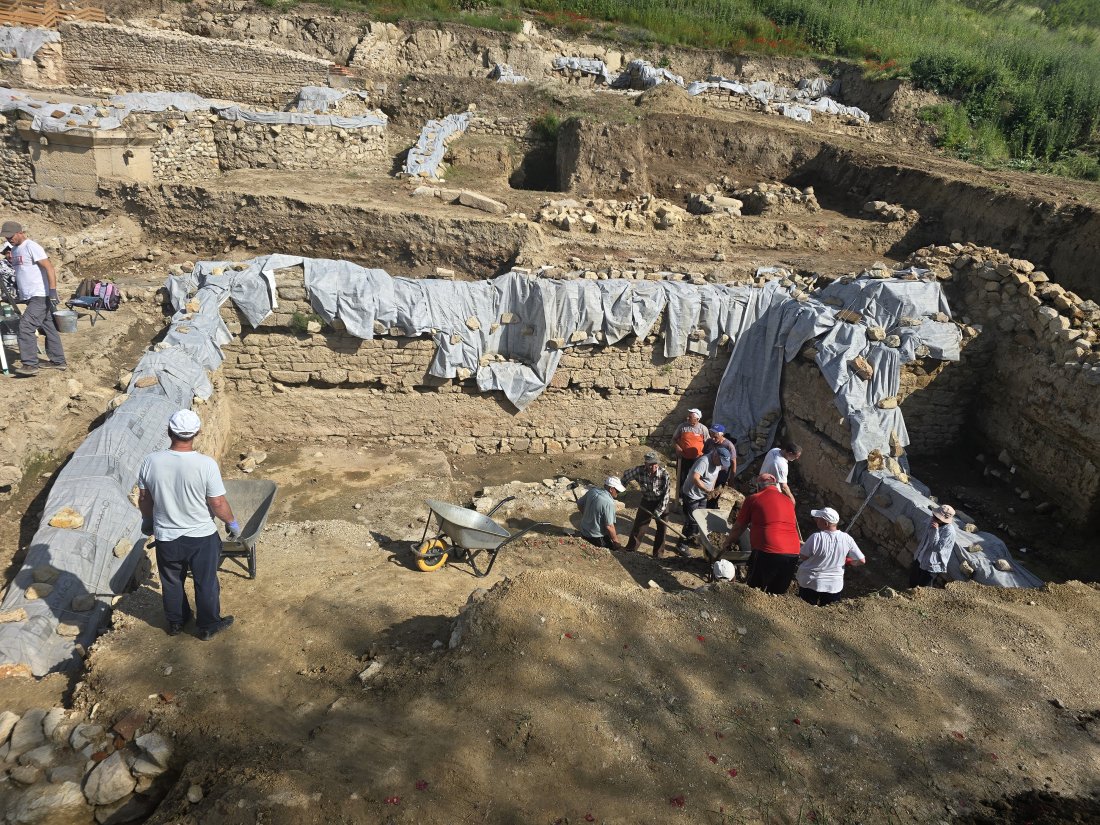
A fragment of a marble statue of a goddess has been discovered during archaeological excavations at the ancient city of Heraclea Sintica. The find was made in the area of the Temple of Heracles and, according to preliminary assessments, may form part of a sculptural depiction of the goddess Artemis. This was announced by the head of the excavation team, Prof. Dr. Lyudmil Vagalinski.
The uncovered fragment consists of a base with the feet of a human figure wearing sandals. According to the archaeologist, Artemis is among the most venerated deities in the region in antiquity, and such an identification of the statue is entirely plausible at this stage of the research. The artefact was found in front of the investigated Temple of Heracles. The team will continue working in the area in the hope of discovering additional parts of the sculpture.
Prof. Vagalinski recalled that previous archaeological excavations at Heraclea Sintica have uncovered various fragments of statues. Among them is a head of a young woman, currently housed in the History Museum in Petrich, for which researchers have already suggested it may represent Artemis.
A huge marble statue of a deity discovered by archaeologists in ancient city of Heraclea Sintica near Petrich
The Second Statue Discovered at Heraclea Sintica Has Now Been Restored (PHOTOS)
The second statue discovered in the ancient city of Heraclea Sintica is transported to the museum in Petrich
“Next we will examine whether this head could belong to the sculpture of which we are now finding a part. We will carry out comparative marble analyses together with specialists from Sofia University,” he said.
In close proximity to the newly discovered fragment, archaeologists have also found other pieces of marble sculptures. According to the head of the excavations, it remains to be determined whether they belong to the same monument or represent remains of more than one statue. Preliminary stratigraphic data suggest that the sculpture was likely damaged and toppled at the end of the 3rd century AD, when the city suffered severe attacks and destruction. Later, in the 4th century, it was no longer used in cult practice.
“These are initial conclusions which will need to be confirmed through further analysis. But for now, the data point to precisely such a history of the monument,” Vagalinski explained.
The archaeologist expressed hope that the excavations will lead to the discovery of the remaining parts of the sculpture. He recalled the case from 2024, when during research on the Great Canal at Heraclea Sintica, a statue was discovered whose head had initially been thought lost irretrievably. It was later found around 6.5 metres from the body at the bottom of the structure.
“Heraclea always surprises us. That is why we remain hopeful that we will also find the remaining parts of this statue, including its head. We have not yet completed the investigation of the cultural layer and the interior of the temple,” Prof. Vagalinski said.
Source: BTA







 Чуй новините
 Подкаст