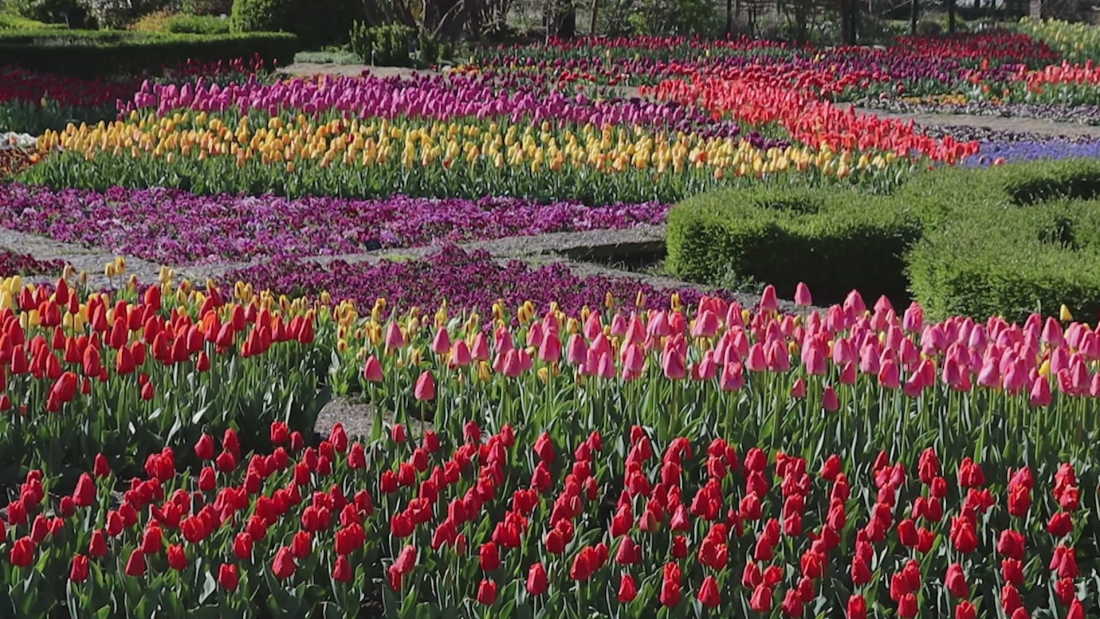
A tulip parade can be viewed for the 13th consecutive year at the University Botanical Garden in the town of Balchik. This year, more than 60,000 tulips of 85 varieties are on display, each more beautiful than the next. For the first time, botanists are also presenting a daisy parade.
Each year, thousands of bulbs from different varieties are planted here, and they bloom at different times. This is why the flowering process is referred to as a “parade”.
Vanya Radeva, chief specialist at the University Botanical Garden in Balchik, said: “Early-, mid- and late-flowering varieties are all represented. The idea is that during this little over a month when the tulip parade takes place, tourists who visit can see tulips in bloom at any given moment, as the early ones are already at their peak, and some are already beginning to fade, while the mid-season varieties are just starting to bloom.”
The palette is exceptionally rich in colours – from white to black – as well as in forms.
Vanya Radeva: “We have peony-flowered, lily-flowered, bicoloured, and parrot tulips.”
‘Serdika’ is the only Bulgarian tulip variety, but it is in no way inferior to the Dutch ones. The garden also carefully preserves wild representatives of the species.
Vanya Radeva said: “We expect the late-flowering tulips to finish at the beginning of May. In addition to tulips, our flower beds and arrangements include 44 varieties of violets and 4 varieties of forget-me-nots. This year, for the first time, we are also hosting a daisy parade, with 16 varieties of daisies. Daisies are somewhat special plants – they are winter-hardy, perennial, and very beautiful.”
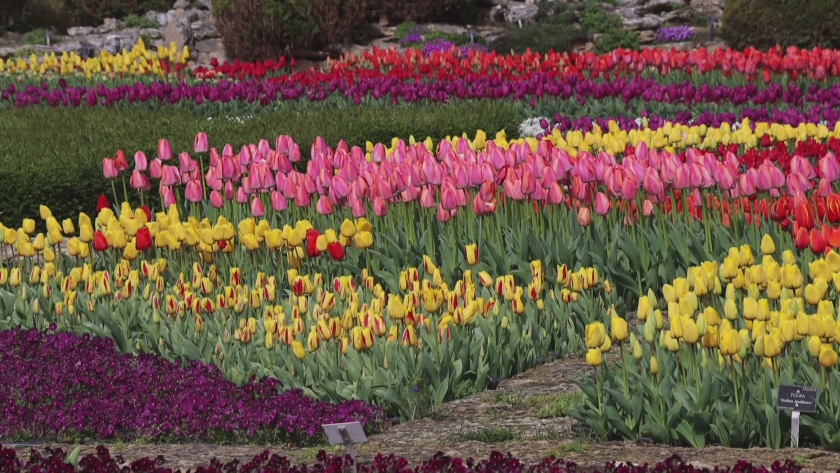
Plant species in the garden are combined according to height, colour and the size of their flowers. There are more than 100,000 spring bulb plants alone, and 35 people take care of them and all the other plants.
Vanya Radeva: “Our garden covers 194 decares, with more than 5,000 perennial, cold-resistant plants suitable for our climate. We also have plants that we bring into working greenhouses in October, take care of throughout the winter, and then bring outside in April, simply because they are heat-loving or tropical collections.”
With the summer planting, the botanists are also preparing a new surprise for visitors – a musical garden.
Vanya Radeva: “Every single plant emits music, which we cannot hear naturally, but it can be captured in a special way using specialised equipment. The plants we select and the music that is most suitable will be recorded and made accessible via a QR code, so it can be scanned with a phone, allowing anyone who wishes to listen to the music of the respective plant.”
The first “musical” plant comes from the garden’s emblematic collection – a more than 110-year-old Mexican cactus.








 Чуй новините
 Подкаст