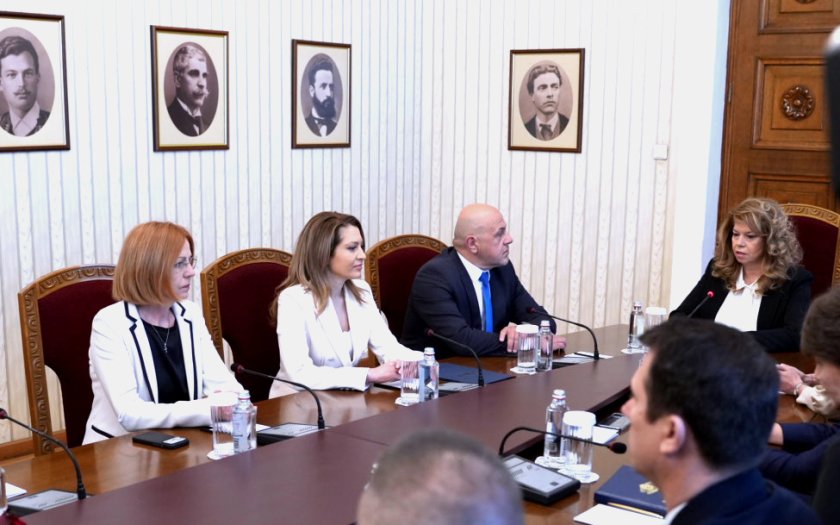
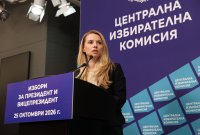
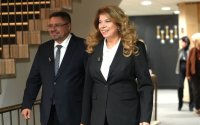
President Iliana Iotova has received representatives of the GERB–UDF parliamentary group at the presidency on Dondukov 2, as part of consultations with parties represented in Parliament ahead of handing over the first mandate to seek to form a government.
Addressing the delegation, President Iotova thanked them for their constructive approach at what she described as a tense political moment. She also acknowledged their opening remarks at the inaugural sitting of the 52nd National Assembly, noting a clear willingness for constructive engagement during the upcoming term.
“Bulgaria is in a new political situation not seen for more than 20 years. A single political formation — the leading force, ‘Progressive Bulgaria’ — has secured an absolute majority. We hope for stability and for a developed and prosperous Bulgaria, in which the role of the opposition in the National Assembly will be of great importance,” she said.
She added that she was counting on GERB–UDF’s experience as a long-standing governing force, including its expertise and capacity to contribute ideas, as well as to exercise effective parliamentary oversight and help foster improved relations between institutions.
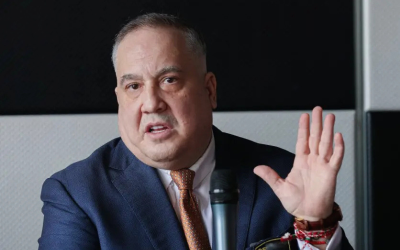
Tomislav Donchev of GERB–UDF thanked the President for efforts to give substance to the formal consultation process.
“An experienced politician such as yourself knows that short-term horizons in politics are dangerous. They often result in energy being wasted, rather than channelled into pragmatic, long-term action,” he said.
“In that sense, the most important priority for us is for Bulgaria to have a regular, fully mandated government as soon as possible. The conditions are there, and there is parliamentary support, so that it can address the key challenges facing the country — first and foremost, the budget.”
Donchev said his party would favour a course towards fiscal consolidation, including reducing the deficit — a goal he suggested could command broad support across parliament.
“This is not about party interest, but about the future of the country. We cannot afford a permanent path of rising debt. After five years of budgetary voluntarism, the time has come for difficult decisions,” he added.
While noting that the role of the opposition is typically to criticise and offer alternatives, he said GERB–UDF would be prepared to support certain difficult decisions, particularly those with a reform-oriented focus.
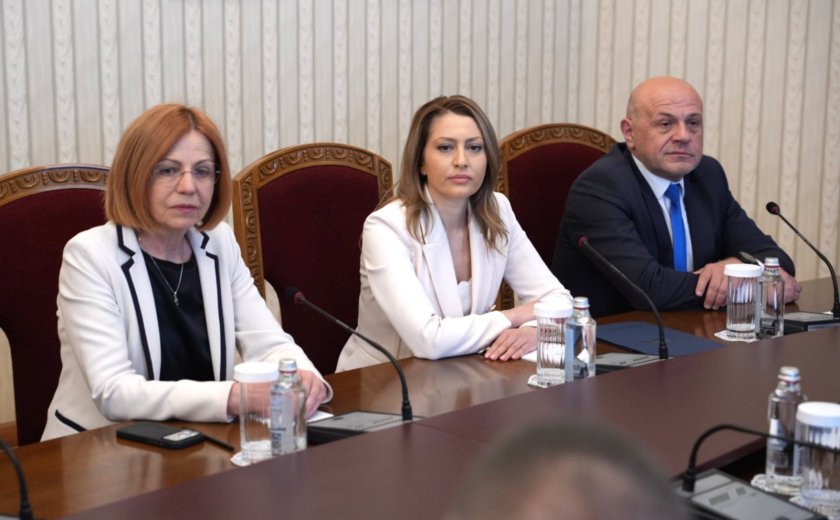
The quality of governance depends not only on the behaviour of the government, it also depends on the activities of the opposition, Donchev said.
Donchev said the quality of governance depends not only on those in power, but also on the performance of the opposition.
“Voters have assigned us the role of opposition. Given the result we received, we intend to fulfil that role with the utmost responsibility. According to modern political theory, the quality of governance depends not only on the conduct of those in government, but also on the work of the opposition.
In that sense, through all our actions, we will do everything possible to improve the quality of governance — to support the government when it proposes sound policies, to criticise it when decisions are wrong, and to present alternative policies where appropriate and feasible. That is the role of the opposition.”
Donchev also warned that investment activity tends to slow during political transitions.
“Bulgaria faces challenges not only related to the Recovery and Resilience Plan. It is regrettable that the previous National Assembly failed to secure sufficient support to pass some of the necessary reforms. We will lend support, as we already have draft legislation prepared from our time in government.
However, under no circumstances should the pace of investment be allowed to slow. Not only under the Recovery Plan — as you know — but also under operational programmes, there are annual deadlines, and if payments fall below target levels, funding is lost.
Experience shows that during a change of administration, investment activity almost always slows. This must not be allowed to happen, as these are funds intended for Bulgarian citizens, businesses and municipalities.
We will continue to propose legislative initiatives and new ideas in key areas, including education, industrial policy, innovation and research and development. I firmly believe that the practice of granting tax incentives to companies investing in research and development should be maintained.”
Raya Nazaryan of GERB–UDF said that all sound and workable proposals related to judicial reform could count on her party’s support, as well as on its own contributions.
“I am genuinely pleased that there is now a stable majority which has moved swiftly to fulfil all constitutional procedures and obligations — including the rapid election of a Speaker and meeting public expectations for stability, security and confidence in the legislature.
I would like to wish Ms Dotseva every success and I am confident she will manage. She can rely on my support in any way I can assist, as someone who has held this position and has the relevant experience.
We will not allow the poor practices seen in the past, caused by severe fragmentation in the National Assembly, to continue now, when there is an opportunity to present a different face of the legislature.
Of course, we will continue our efforts on the legislative agenda, as Mr Donchev has said. Regarding the Recovery and Resilience Plan, we have been directly involved in drafting many of the laws and have authored a number of the texts — these remain a priority for us.
All good and effective proposals concerning judicial reform can count on our support, as well as on proposals from our side.”
Yordanka Fandakova highlighted education and culture as key priorities.
“I would like to add one important topic, in which you also have both sensitivity and expertise — education. We therefore expect the modernisation of Bulgarian education to continue swiftly.
We have already put forward initiatives, and a draft law has passed its first reading. I hope we can achieve full consensus — in other words, restore consensus on education, and, of course, on culture as well.”








 Чуй новините
 Подкаст